Magic: The Gathering
Events
WPN May Events
Magic: The Gathering: Casual Play: Here, you rule. Come to play, trade, or build decks for Magic: the Gathering. Decks available for use. New Players Welcome.
Tuesdays: 3,10,17,24,31
Friday Night Magic: Here, you rule. Standard type 2 constructed event. $7.00 entry. DCI sanctioned w/ prize support! Hosted by Dan Regewitz.
Fridays: 6,20,; 5:30pm - 9:00pm
Friday Night Magic: Here, you rule. New Phyrexia Draft event. $16.00 entry. DCI sanctioned w/ prize support! Hosted by Dan Regewitz.
Fridays: 27; 5:30pm - 9:00pm
New Phyrexia Pre-release!: Once again NDC is proud to host an officially sanctioned pre-release event. A Scars of Mirrodin Block sealed deck event featuring the newest set, New Phyrexia. $30.00 entry fee w/ prize support! Days events to include free play ($16.00) and sanctioned draft ($16.00) if time allows. Hosted by Dan Regewitz.
Saturday: 7th; 11:30 registration; Play 12:30-5:30; Draft 6:00-9:00
New Phyrexia Launch!: Celebrate the official launch of the Magic set New Phyrexia in this Draft event. $16.00 entry. DCI sanctioned w/ prize support! Hosted by Dan Regewitz.
Friday: 13th; 5:30-9:00pm.
WPN June Events
Magic: The Gathering: Casual Play: Here, you rule. Come to play, trade, or build decks for Magic: the Gathering. Decks available for use. New Players Welcome.
Tuesdays: 7,14,21,28
Friday Night Magic: Here, you rule. Standard type 2 constructed event. $7.00 entry. DCI sanctioned w/ prize support! Hosted by Dan Regewitz.
Fridays: 3,10,24; 5:30pm - 9:00pm
Friday Night Magic: Here, you rule. Join us for our monthly draft event. We should be drafting Scars Block.$16.00 entry. DCI sanctioned w/ prize support! Hosted by Dan Regewitz.
Friday 17; 5:30pm - 9:00pm
New Phyrexia Game Day: Experience the power of play. Standard constructed. Exclusive promos to be handed out to all participants and additional promos to be handed out to the top 8 finishers. Here you Rule! $10.00 entry. Prizes based on attendance. Hosted by Dan Regewitz.
Sat, 11th 12:00 noon-9:00pm
Commander Release Event: Experience the power of Commander! This 100 card singleton format is so awesome that I will be hosting a special "sealed" event. Bring your own sealed or unmodified deck out of the "commander" product line and let multiplayer madness begin! Product available for sale. $5.00 entry. Prizes based on attendance. Hosted by Dan Regewitz.
Tues, 21st; 4:30pm-9:00pm
Future Events
2011-07-09 -11-07-2782931 -Prerelease - M12 - US
2011-07-09 -11-07-2782932 -SIDE EVENTS - M12 Prerelease
2011-07-15 -11-07-2782928 -Launch Party - M12
Monday, April 25, 2011


Sunday, April 10, 2011
12 tips for the aspiring Commander
= 12 tips for the aspiring Commander
In my continuing quest to educate the masses about the Highlander/Commander format and the many joys of playing, I have devised a short 12 item list. This list is not intended to be complete or definitive. It's simply 12 strategies that work well in almost any Commander deck. I highly recommend considering including these strategies when building a deck or otherwise making card choices. They are in no particular order save the order I wish to discuss them in.
- Push creatures through (evasion)
The board can get fairly clogged in a commander game. By that I mean that it can be littered with creatures. In such a situation no player wants to attack because they risk loosing creatures and/or making themselves a target of retaliation. A creature that can both attack and block is therefore valuable (creatures with vigilance don't tap to attack, and are therefore available to block). Likewise a creature who cannot be blocked by an opponent is also a suitable attacker. Abilities that make creatures harder to block are loosely called "evasion" abilities, and include such things as flying, intimidate, landwalk, etc.
Flying and Trample are both evasion Abilities
- Deal with creatures (single target removal, board wipes).
A board wipe is any spell or ability that effectively gets rid of all creatures. Because creatures pose a threat in the form of attacking damage (not to mention useful abilities). Thus, it is very useful to have a 'release valve' that can reset the board. Remember, the probability of board wipe is 1. Some creatures can be very potent threats, and therefore it's also a good idea to have a few effects that can take out a single creature with pinpoint accuracy - for those situations where you need to deal with a threat right now.
The most traditional Board Wipe.
- Build for trouble (artifacts, enchantments)
Just as creatures can pose a significant threat, so can artifacts and enchantments. You can almost certainly find a few artifacts and enchantments to help your deck along it's path to victory. If you happen to be running some sort of combo deck, chances are one of your key combo pieces is an artifact or enchantment. If you can find some useful tools for your deck, then so can your opponent. Come prepared to remove a few of each type.
Hates Artifacts or Enchantments.
- Scale it up (play some higher cost spells)
Commander games take longer than normal games of magic. Partly because players start with 40 life, partly because decks are 99 cards deep, but also partly because players opt to play cards that (on average) have higher costs than decks in other formats. When building a deck it's a good idea to keep in mind that in most commander games your going to have a little extra time to get some mana, and cast spells that are 5-7 mana range (or higher). Cards like Darksteel Colossus are generally considered unplayable in standard, but are quite playable in Commander.
Really large spells can be worth it.
- Permanents are King (repeatable effects rule)
To illustrate a point I want you to look at two cards. Boomerang, and Temporal Adept.
Boomerang
Temporal Adept
Both of these cards perform the same function. Namely, to return permanents from the field to owner's hand (or 'bounce'). Boomerang as an instant has a certain surprise factor because your opponent doesn't know you have it until it comes out of your hand. Temporal Adept on the other hand can Boomerang every single turn for only one more blue mana, and tapping it, for as long as you can keep it on the field. Partly due to the fact that Commander games are longer, many players will prefer Temporal Adept. The Adept provides an advantage that can be maintained over several turns.
This is not to say that you shouldn't play instant and sorcery spells, just that a permanent is often better than a spell that performs the same function.
- Friend or Foe: Planeswalkers
Planeswalkers can be very useful cards because they are permanents that provide once-a-turn effects (see above). There are also limited options for dealing with them, mostly attacking and redirecting burn spells. Because of this, they are often attractive cards to include in a deck. However, fielding a planeswalker without adequate defense typically means that it will simply die after one effect. Also they tend to "draw hate" from the rest of the table - by which I mean that other players really don't want you to activate the last, often called the "ultimate" ability of any planeswalker, and will take active steps to fight it.
Be mindful if someone resolves a planeswalker. Who is it and what are they doing with it? If it's a Garruk and they spend two or three turns untapping land to play some more spells - well let's just say you better be prepared for an overrun.
Planeswalkers are a double-edged sword, sometimes.
- Use the graveyard (bring stuff back)
Any deck is filled with resources. When these resources are spent (by casting or in combat), they are sent to the graveyard. Which is why it's often a good idea to bring them back and use them again. Because you can only play one copy of any given card in a Commander deck, it's a very good idea to be able to dig through your graveyard and bring cards that are useful in the current situation back. This includes mass effects like Elixir of immortality, but also targeted effects like Regrowth or Raise dead.
Reuse the graveyard, somehow.
- Land ho (non-basic lands)
Most lands generate mana, but some lands don't have to. There are lands that can bring back creatures, prevent or deal damage, become creatures for a turn, give a creature a temporary boost or ability, or give you no maximum hand size (one of my favorites). Lands are just another resource for your deck, and while they are there to provide mana for spells - there is nothing wrong with some of them also doing something else, or a few of them doing something instead of that whole mana thing!
Which is why it's a good idea to include a card or two that can destroy a land (or two). Just as artifacts or enchantments can create enough trouble to be worth getting rid of, so can land.
The most classic of the hated non-basics.
- Gain some life
You might think that 40 life is a lot. The thing is with life, is that it can't hurt to have a little more. Including some way to gain life (or prevent damage) can keep you in the game and playing for longer. This should enable you to see more cards of your deck, and interact more in the game.
Conversely, keep in mind the rules about commander damage (which say that if you take 21 points of accumulated damage from a single commander you loose the game). These rules exist to keep the game interesting and preventing players from being able to play with a deck that gains so much life it can't loose.
Life is the stuff of life.
- Draw some Cards.
Just as gaining a bit of extra life will help you in a long game, so to will drawing a few extra cards. This goes back to the whole concept of each card in your deck being a resource. If you are drawing multiple cards in a turn, you acquire multiple resources a turn. This gives you a wider or better selection of possible plays on the subsequent turn. Also it allows you to see more cards in your deck over a set number of turns, which means you will simply see more cards that you want or need.
Be generous (or greedy) with cards.
- Dueling Grounds
No, not the card. I'm actually referring to land. Land is the primary resource. Without it, all of your other resource spells go to waste. Thus, it is important to get land, get land in the right color(s), and get enough land to fuel all the fun things you want to do in a game. Thus it is often a good idea to find spells or abilities that allow you to search land out of your deck and put them someplace useful (like your hand or the battlefield). Artifacts can also serve the same purpose as land. There are many "Mana Rocks" in the game - artifacts with abilities that can add mana to one's mana pool. Mana filtering (changing one color of mana into another) is also relevant in 3-5 color decks.
Explore new Lands!
- Have Fun!
Repeat after me: If you aren't having fun, your doing it wrong!
In my continuing quest to educate the masses about the Highlander/Commander format and the many joys of playing, I have devised a short 12 item list. This list is not intended to be complete or definitive. It's simply 12 strategies that work well in almost any Commander deck. I highly recommend considering including these strategies when building a deck or otherwise making card choices. They are in no particular order save the order I wish to discuss them in.
- Push creatures through (evasion)
The board can get fairly clogged in a commander game. By that I mean that it can be littered with creatures. In such a situation no player wants to attack because they risk loosing creatures and/or making themselves a target of retaliation. A creature that can both attack and block is therefore valuable (creatures with vigilance don't tap to attack, and are therefore available to block). Likewise a creature who cannot be blocked by an opponent is also a suitable attacker. Abilities that make creatures harder to block are loosely called "evasion" abilities, and include such things as flying, intimidate, landwalk, etc.
Flying and Trample are both evasion Abilities
- Deal with creatures (single target removal, board wipes).
A board wipe is any spell or ability that effectively gets rid of all creatures. Because creatures pose a threat in the form of attacking damage (not to mention useful abilities). Thus, it is very useful to have a 'release valve' that can reset the board. Remember, the probability of board wipe is 1. Some creatures can be very potent threats, and therefore it's also a good idea to have a few effects that can take out a single creature with pinpoint accuracy - for those situations where you need to deal with a threat right now.
The most traditional Board Wipe.
- Build for trouble (artifacts, enchantments)
Just as creatures can pose a significant threat, so can artifacts and enchantments. You can almost certainly find a few artifacts and enchantments to help your deck along it's path to victory. If you happen to be running some sort of combo deck, chances are one of your key combo pieces is an artifact or enchantment. If you can find some useful tools for your deck, then so can your opponent. Come prepared to remove a few of each type.
Hates Artifacts or Enchantments.
- Scale it up (play some higher cost spells)
Commander games take longer than normal games of magic. Partly because players start with 40 life, partly because decks are 99 cards deep, but also partly because players opt to play cards that (on average) have higher costs than decks in other formats. When building a deck it's a good idea to keep in mind that in most commander games your going to have a little extra time to get some mana, and cast spells that are 5-7 mana range (or higher). Cards like Darksteel Colossus are generally considered unplayable in standard, but are quite playable in Commander.
Really large spells can be worth it.
- Permanents are King (repeatable effects rule)
To illustrate a point I want you to look at two cards. Boomerang, and Temporal Adept.
Boomerang
Temporal Adept
Both of these cards perform the same function. Namely, to return permanents from the field to owner's hand (or 'bounce'). Boomerang as an instant has a certain surprise factor because your opponent doesn't know you have it until it comes out of your hand. Temporal Adept on the other hand can Boomerang every single turn for only one more blue mana, and tapping it, for as long as you can keep it on the field. Partly due to the fact that Commander games are longer, many players will prefer Temporal Adept. The Adept provides an advantage that can be maintained over several turns.
This is not to say that you shouldn't play instant and sorcery spells, just that a permanent is often better than a spell that performs the same function.
- Friend or Foe: Planeswalkers
Planeswalkers can be very useful cards because they are permanents that provide once-a-turn effects (see above). There are also limited options for dealing with them, mostly attacking and redirecting burn spells. Because of this, they are often attractive cards to include in a deck. However, fielding a planeswalker without adequate defense typically means that it will simply die after one effect. Also they tend to "draw hate" from the rest of the table - by which I mean that other players really don't want you to activate the last, often called the "ultimate" ability of any planeswalker, and will take active steps to fight it.
Be mindful if someone resolves a planeswalker. Who is it and what are they doing with it? If it's a Garruk and they spend two or three turns untapping land to play some more spells - well let's just say you better be prepared for an overrun.
Planeswalkers are a double-edged sword, sometimes.
- Use the graveyard (bring stuff back)
Any deck is filled with resources. When these resources are spent (by casting or in combat), they are sent to the graveyard. Which is why it's often a good idea to bring them back and use them again. Because you can only play one copy of any given card in a Commander deck, it's a very good idea to be able to dig through your graveyard and bring cards that are useful in the current situation back. This includes mass effects like Elixir of immortality, but also targeted effects like Regrowth or Raise dead.
Reuse the graveyard, somehow.
- Land ho (non-basic lands)
Most lands generate mana, but some lands don't have to. There are lands that can bring back creatures, prevent or deal damage, become creatures for a turn, give a creature a temporary boost or ability, or give you no maximum hand size (one of my favorites). Lands are just another resource for your deck, and while they are there to provide mana for spells - there is nothing wrong with some of them also doing something else, or a few of them doing something instead of that whole mana thing!
Which is why it's a good idea to include a card or two that can destroy a land (or two). Just as artifacts or enchantments can create enough trouble to be worth getting rid of, so can land.
The most classic of the hated non-basics.
- Gain some life
You might think that 40 life is a lot. The thing is with life, is that it can't hurt to have a little more. Including some way to gain life (or prevent damage) can keep you in the game and playing for longer. This should enable you to see more cards of your deck, and interact more in the game.
Conversely, keep in mind the rules about commander damage (which say that if you take 21 points of accumulated damage from a single commander you loose the game). These rules exist to keep the game interesting and preventing players from being able to play with a deck that gains so much life it can't loose.
Life is the stuff of life.
- Draw some Cards.
Just as gaining a bit of extra life will help you in a long game, so to will drawing a few extra cards. This goes back to the whole concept of each card in your deck being a resource. If you are drawing multiple cards in a turn, you acquire multiple resources a turn. This gives you a wider or better selection of possible plays on the subsequent turn. Also it allows you to see more cards in your deck over a set number of turns, which means you will simply see more cards that you want or need.
Be generous (or greedy) with cards.
- Dueling Grounds
No, not the card. I'm actually referring to land. Land is the primary resource. Without it, all of your other resource spells go to waste. Thus, it is important to get land, get land in the right color(s), and get enough land to fuel all the fun things you want to do in a game. Thus it is often a good idea to find spells or abilities that allow you to search land out of your deck and put them someplace useful (like your hand or the battlefield). Artifacts can also serve the same purpose as land. There are many "Mana Rocks" in the game - artifacts with abilities that can add mana to one's mana pool. Mana filtering (changing one color of mana into another) is also relevant in 3-5 color decks.
Explore new Lands!
- Have Fun!
Repeat after me: If you aren't having fun, your doing it wrong!
Sunday, April 3, 2011
Commander: Testing
= Commander: Testing
I did mention testing, so I'm going to talk just a bit about how to do that. First of all, you can start testing in your own home.
- Test hands
The first method of testing the deck you just put together is to look at an opening hand. If you don't like the look of the first one you see, feel free to shuffle and take seven more. For each hand that you look at consider the following: Do you have enough land? Do you have the right colors? What's the earliest you could play a spell using just those 7 cards? Would you keep this if you were sitting down to a game with a real, live opponent?
Commander decks are naturally slower than other smaller constructed decks, so take this into consideration. I frequently look at sets of 10 cards (representing my first three draws) to determine if the deck has draws that I'd like to see and can play with.

This looks like a good hand to me personally. No spells to cast, but I have a first-turn reliquary tower, which is always a good sign, and plenty of land and all three colors.
- Goldfish
A "goldfish" is basically a solitare game that you play against no opponent. You simply draw cards, play land, cast spells, and repeat this process. The goal is to see if the cards you picked are doing what you expected them to do. Is your deck following your strategy? Are the expected synergies there? In the right quantities? At any point do you want some effect that simply isn't in your deck?

After a particularly extended Goldfish, I decide to debate prior card choices. I wanted more Auras during the game, so here I consider two I previously cut (left) for some less synergistic enchantments from my deck (right)
- Live test
Of course some of the best feedback you can get for any deck is to take it to a game table near you and play it against another player playing one of their own decks. It forces you to deal with threats, interact with what your opponent has on the field, plus get another player's opinion on how, how well, and why your deck works (or doesn't).
- So is it done?
Of course not! Yes you have a playable deck, and it might even be reasonably good. But you can learn more about magic, you can become a better player, and you can become a better deck builder. As you grow, so can your deck. You can revise it to make it better. Or you can revise it to make it more fun. Or you can revise it so that it focuses on a different theme or sub-theme. Or you can build a new deck (one of my favorites).
Whatever it is you do, have fun slinging some spells!
I did mention testing, so I'm going to talk just a bit about how to do that. First of all, you can start testing in your own home.
- Test hands
The first method of testing the deck you just put together is to look at an opening hand. If you don't like the look of the first one you see, feel free to shuffle and take seven more. For each hand that you look at consider the following: Do you have enough land? Do you have the right colors? What's the earliest you could play a spell using just those 7 cards? Would you keep this if you were sitting down to a game with a real, live opponent?
Commander decks are naturally slower than other smaller constructed decks, so take this into consideration. I frequently look at sets of 10 cards (representing my first three draws) to determine if the deck has draws that I'd like to see and can play with.
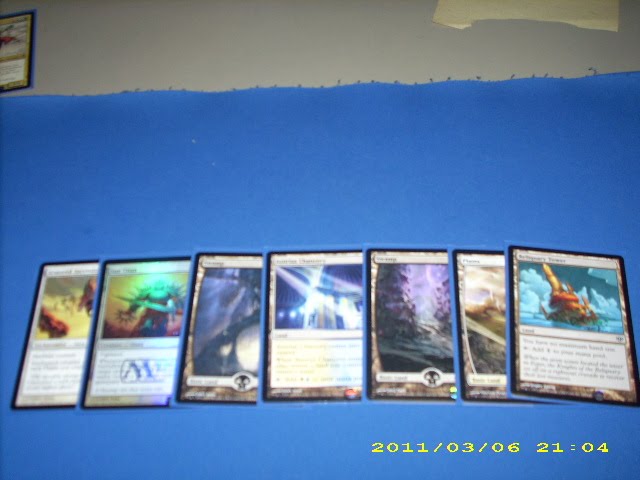
This looks like a good hand to me personally. No spells to cast, but I have a first-turn reliquary tower, which is always a good sign, and plenty of land and all three colors.
- Goldfish
A "goldfish" is basically a solitare game that you play against no opponent. You simply draw cards, play land, cast spells, and repeat this process. The goal is to see if the cards you picked are doing what you expected them to do. Is your deck following your strategy? Are the expected synergies there? In the right quantities? At any point do you want some effect that simply isn't in your deck?

After a particularly extended Goldfish, I decide to debate prior card choices. I wanted more Auras during the game, so here I consider two I previously cut (left) for some less synergistic enchantments from my deck (right)
- Live test
Of course some of the best feedback you can get for any deck is to take it to a game table near you and play it against another player playing one of their own decks. It forces you to deal with threats, interact with what your opponent has on the field, plus get another player's opinion on how, how well, and why your deck works (or doesn't).
- So is it done?
Of course not! Yes you have a playable deck, and it might even be reasonably good. But you can learn more about magic, you can become a better player, and you can become a better deck builder. As you grow, so can your deck. You can revise it to make it better. Or you can revise it to make it more fun. Or you can revise it so that it focuses on a different theme or sub-theme. Or you can build a new deck (one of my favorites).
Whatever it is you do, have fun slinging some spells!
Thursday, March 31, 2011
Magic Events April, May
Magic: The Gathering
Events
WPN April Events
Magic: The Gathering: Casual Play: Here, you rule. Come to play, trade, or build decks for Magic: the Gathering. Decks available for use. New Players Welcome.
Tuesdays: 5,12,19,26; 5:30-9:00pm
Friday Night Magic: Here, you rule. Standard type 2 constructed event. $7.00 entry. DCI sanctioned w/ prize support! Hosted by Dan Regewitz.
Fridays: 8,22,29; 5:30pm - 9:00pm
FNM; Two-Headed Giant: Totally not a joke. Enjoy a change of pace with a Two-Headed Sealed event. Each team of 2 will receive 8 packs of Scars/Besieged product. Entry $16.00 per player or $32.00 per team. DCI sanctioned w/ prize support! FNM and other promos offered as random door prizes. Hosted by Dan Regewitz.
Friday, April 1st, 5:00-9:00pm.
Commander Event: Participate in the most awesome format ever. Elder Dragon Highlander AKA Commander. 100card singleton commander format. Multi-player with victory points. $10.00 entry. Prizes to be distributed as store credit.
Tues, April 12th 4:00pm-9:00pm Note: the date of this event has changed.
WPN May Events
Magic: The Gathering: Casual Play: Here, you rule. Come to play, trade, or build decks for Magic: the Gathering. Decks available for use. New Players Welcome.
Tuesdays: 3,10,17,24,31
Friday Night Magic: Here, you rule. Standard type 2 constructed event. $7.00 entry. DCI sanctioned w/ prize support! Hosted by Dan Regewitz.
Fridays: 6,20,; 5:30pm - 9:00pm
Friday Night Magic: Here, you rule. New Phyrexia Draft event. $16.00 entry. DCI sanctioned w/ prize support! Hosted by Dan Regewitz.
Fridays: 27; 5:30pm - 9:00pm
New Phyrexia Pre-release!: Once again NDC is proud to host an officially sanctioned pre-release event. A Scars of Mirrodin Block sealed deck event featuring the newest set, New Phyrexia. $30.00 entry fee w/ prize support! Days events to include free play ($16.00) and sanctioned draft ($16.00) if time allows. Hosted by Dan Regewitz.
Saturday: 7th; 11:30 registration; Play 12:30-5:30; Draft 6:00-9:00
New Phyrexia Launch!: Celebrate the official launch of the Magic set New Phyrexia in this Draft event. $16.00 entry. DCI sanctioned w/ prize support! Hosted by Dan Regewitz.
Friday: 13th; 5:30-9:00pm.
Future Events
2011-06-11 -New Phyrexia Game Gay (standard)
Events
WPN April Events
Magic: The Gathering: Casual Play: Here, you rule. Come to play, trade, or build decks for Magic: the Gathering. Decks available for use. New Players Welcome.
Tuesdays: 5,12,19,26; 5:30-9:00pm
Friday Night Magic: Here, you rule. Standard type 2 constructed event. $7.00 entry. DCI sanctioned w/ prize support! Hosted by Dan Regewitz.
Fridays: 8,22,29; 5:30pm - 9:00pm
FNM; Two-Headed Giant: Totally not a joke. Enjoy a change of pace with a Two-Headed Sealed event. Each team of 2 will receive 8 packs of Scars/Besieged product. Entry $16.00 per player or $32.00 per team. DCI sanctioned w/ prize support! FNM and other promos offered as random door prizes. Hosted by Dan Regewitz.
Friday, April 1st, 5:00-9:00pm.
Commander Event: Participate in the most awesome format ever. Elder Dragon Highlander AKA Commander. 100card singleton commander format. Multi-player with victory points. $10.00 entry. Prizes to be distributed as store credit.
Tues, April 12th 4:00pm-9:00pm Note: the date of this event has changed.
WPN May Events
Magic: The Gathering: Casual Play: Here, you rule. Come to play, trade, or build decks for Magic: the Gathering. Decks available for use. New Players Welcome.
Tuesdays: 3,10,17,24,31
Friday Night Magic: Here, you rule. Standard type 2 constructed event. $7.00 entry. DCI sanctioned w/ prize support! Hosted by Dan Regewitz.
Fridays: 6,20,; 5:30pm - 9:00pm
Friday Night Magic: Here, you rule. New Phyrexia Draft event. $16.00 entry. DCI sanctioned w/ prize support! Hosted by Dan Regewitz.
Fridays: 27; 5:30pm - 9:00pm
New Phyrexia Pre-release!: Once again NDC is proud to host an officially sanctioned pre-release event. A Scars of Mirrodin Block sealed deck event featuring the newest set, New Phyrexia. $30.00 entry fee w/ prize support! Days events to include free play ($16.00) and sanctioned draft ($16.00) if time allows. Hosted by Dan Regewitz.
Saturday: 7th; 11:30 registration; Play 12:30-5:30; Draft 6:00-9:00
New Phyrexia Launch!: Celebrate the official launch of the Magic set New Phyrexia in this Draft event. $16.00 entry. DCI sanctioned w/ prize support! Hosted by Dan Regewitz.
Friday: 13th; 5:30-9:00pm.
Future Events
2011-06-11 -New Phyrexia Game Gay (standard)
Saturday, March 26, 2011
Commander: It's all in the cards.
= It's all in the cards.
If you've never built a Commander deck before, it kinda goes without saying that your going to need cards to build with. Even someone like myself who's a big fan of the format with multiple decks under my belt, goes out of their way to acquire cards when attempting to build a new Commander deck.
You're going to need a lot of cards.

Ok, maybe not that many. Although you can build with every card ever printed, remember the limitations of the Commander format. You have to stay in-color with your chosen Commander, you can only run one copy of any given card. You can also start picking your effects now. Running black, but creatures not a big part of your game plan? Don't grab Raise Dead or similar effects. Also low cost creatures (without abilities) are dead draws in Commander as a format

Ah, that's more like it. This is where my last 2 Commander decks started. As approximately 400 loose cards. It took me roughly 4 months to accumulate the selection you see before you by trading with other players, as well as with my FLGS (friendly local gaming store). I spend a good deal of store credit and some cash both locally and online to get this selection of cards to build from.
I want to say that it's OK to have a list of specific Cards that you want to see in your deck. I strongly urge beginners to not build complete deck lists that they see online. Often these lists include expensive singles and aren't going to fit your play style. If you are picking the cards, then there's a good chance the deck is going to be fun for you!
- The Building Process
Why start with so many cards? Because it's relatively easy to cut cards you don't like or don't want. Also starting with 400 cards and cutting down to 60 (not including land), ensures that you get everything you need (but maybe not everything you want) into the deck. Also I find it preferable to finding yourself a few cards short, and attempting to fill those slots with miscellaneous commons you have lying around that quite possibly aren't going to work for your game plan or be syngeristic with the rest of your deck. Worst case scenario they might even work against you. Whereas if you find such cards in your stack of 400, you can simply cut them from consideration, or swap them out for cards you've already cut - but are better than junk.
- Sort your cards
You need to know what you have, before you can get building. I highly suggest sorting all your cards by color and card type. This gives you an idea of what resources your dealing with. It allows you to review your card choices, revise your overall game plan, find patterns, recognize cards that are going to make just about any cut, etc.
The only cards you should cut at this point are those that you have more than one copy of (a no-no for Commander).

Here I have my collection of cards for Zur spread out in front of me. The first row is Non-basic land, then Enchantments by color. The second row is the Commander (Zur), then auras by color. The third row is non-aura, non-creatures by color. The last row is creatures by color.

Slightly more dramatically the stacks are photographed here (left to right) as: Non-basic lands, Enchantments, Auras, Artifacts, Other spells (instants, sorceries, planeswalkers), and creatures.
- The First Cut
Well, the deck cannot come together unless we start to cut cards. I take time to look at each pile that I've made. Within each card type I sort the cards further. Cards that seem really good or fun go into one pile. Cards that seem strong or interesting go into another. Marginal cards go into a third, and cards that I just plain don't like go in a fourth.
Let's not mince words. Your goal here is to cut cards. You should be as brutal as you dare. I typically scoop up the weaker two piles and return them to the box. Culling close to half of my selection in the first or second go-arround.

First cut complete. Looking at the box of 'cut' cards it looks like I managed somewhere below half, but not by much. Not a bad thing.
- Creatures
Creatures are very important to any Commander deck, as they represent the Aggro part of any deck's strategy. Creatures can slowly and incrementally win you just about any game by attacking. Thus any deck should have a few big fat creatures that can win the game conventionally. It's also a good idea to invest some card slots in creatures that have utility functions like fetching land, killing other creatures, destroying pesky permanents (like artifacts or enchantments), and so forth. This is true even if your game plan is to control & combo.
I mentioned "Card slots" there. Let me explain a bit. A commander deck has to be exactly 100 cards. No more, and no less. So when you commit yourself to running a specific card, you've locked that in. By deciding that Zur wants about 20 creatures, and cutting my pile of creatures down to 20 cards, I've not only consumed 20 of my 100 cards total, but I've consumed 20 of my 20 creature cards total.

My 20 creatures, sorted by casting cost ... for now.
- Cut and Cut some more!
This is a process you repeat and repeat again for each stack. Each time you pick up a stack, you try to cut more cards. You distill the piles of junk into stacks of cards that (1) work with your strategy, (2) work synergistically with your other cards, and (3) you really _really_ like!

This picture I snapped somewhere around my 5th or 6th attempt to cut cards. At this point in time I still had 70-some odd cards on the table, and had to cut another 10-15 to pair it down to my final 60. Why 60? Because you need to run Land, and 40 percent is about right for a Commander deck whose spells typically peak in the 3-5 range, and go up to 10. Also keep in mind that I have limited mana-ramping in my chosen colors.
It goes without saying that each time you go back to cut cards, it's going to be more difficult. You may end up revising exactly how many cards your setting aside for creatures, for example. To make more space for say ... enchantments. Which is something I did for Zur.
It might also help to sort your cards using different Criteria. Sorting them by mana cost is something I like to do when I only have a few cards left to cut. I look for mana costs that have a lot of cards at that cost. I then look at all the cards that cost the same, and try to cut a card or two that aren't worth the mana investment compared to other cards of the same cost. I'm particularly critical of spells costing six or more. With that kind of mana investment I should get something that's going to significantly impact the game.

Some more Zur cards, sorted by cost.
You may also want to sort by color. In a multi-color deck like the one I'm building this helps identify if your relying on one color too heavily, or ignoring another.

Looks like it could be a case of too much white, not enough black?
After agonizing over card choices for a while, you eventually settle on a stack that you feel is playable. I ended up with ... 19 Creatures, 11 Other spells, 15 Auras, and 15 Enchantments. Yeah that's 30 total enchantments, but you have to remember that I am building around Zur. Incedentally 20 of those enchantments are casting cost 3 or less, and thus suitable fetches for Zur's ability.
- Mana Balance.
Land is vital to the performance of the deck. The key to figuring out what kind of land you want to run is figuring out what colors your deck is. I know you know what colors your deck is, but the trick is to run land in the right proportion. This is of course a moot point if you happen to be running a mono-colored deck. It's less of a concern for two-color decks, but I would still recommend this process for them. I find it absolutely necessary to do this for 3-5 color decks of any style.
I've worked out an algorithm that works for me and I use for nearly all my magic decks.
(1) Count the number of mana symbols on each card.
I do this step with pen and paper. Using tally marks to mark how many mana symbols of each color appears on each card. I include mana symbols that appear in rules text also. Hybrid symbols count as both colors. Thus Debtors' Knell adds both 3 white and 3 black tallies to my sheet.
Debtors' Knell
(2) Total the number of symbols in each color, and Total mana symbols overall.
For Zur I had 55 white symbols, 30 blue, and 29 black, the deck has a total of 114 mana symbols.
(3) Find the percent of each color in your deck.
This is the number of symbols in a specific color divided by the total symbols in the deck.
(decimals used for accuracy)
White = 55 / 114 = 48.24%
Blue = 30 / 114 = 26.31%
Black = 29 / 114 = 25.43%
(4) Figure out how many land slots your running.
Zur was going to be running 40 land, but I had 20 non-basics to deal with first. Looking at my non-basics I found 14 that I could effectively ignore because they were colorless, any color, or completed sets of multicolor lands (Ravnica bounce and Lorwyn filters). This leaves me with 26 land slots to fill. Note that 6 of these slots will be filled by my remaining 6 non-basics.
(5) Find the number of mana sources you need of each color.
(Land slots multiplied by the percent of the deck in the color your working with above).
White = 26 x .4824 = 12.54 White sources
Blue = 26 x .2631 = 6.84 Blue sources
Black = 26 x .25.43 = 6.61 Black Sources
(6) Get your Basics.
I substituted 2 plains for a Serra's Sanctum and a Celestial Colonnade from my remaining stack of non-basics, and added 10 Plains. (12 Sources).
I substituted 2 Islands for a Faerie Conclave, and Creeping Tar Pit, and grabbed 5 Islands (7 Sources).
I substituted 2 Swamps for a Bojuka Bog and Dreadship Reef, and grabbed 5 Swamps (7 Sources).
Congratulations, you are now ready to sleeve up your deck and give it a test or two.

Um, please use sleeves. You spent all that time and money making this deck, give it some respect. Plus I cringe when I see people shuffle up without them.
If you've never built a Commander deck before, it kinda goes without saying that your going to need cards to build with. Even someone like myself who's a big fan of the format with multiple decks under my belt, goes out of their way to acquire cards when attempting to build a new Commander deck.
You're going to need a lot of cards.

Ok, maybe not that many. Although you can build with every card ever printed, remember the limitations of the Commander format. You have to stay in-color with your chosen Commander, you can only run one copy of any given card. You can also start picking your effects now. Running black, but creatures not a big part of your game plan? Don't grab Raise Dead or similar effects. Also low cost creatures (without abilities) are dead draws in Commander as a format

Ah, that's more like it. This is where my last 2 Commander decks started. As approximately 400 loose cards. It took me roughly 4 months to accumulate the selection you see before you by trading with other players, as well as with my FLGS (friendly local gaming store). I spend a good deal of store credit and some cash both locally and online to get this selection of cards to build from.
I want to say that it's OK to have a list of specific Cards that you want to see in your deck. I strongly urge beginners to not build complete deck lists that they see online. Often these lists include expensive singles and aren't going to fit your play style. If you are picking the cards, then there's a good chance the deck is going to be fun for you!
- The Building Process
Why start with so many cards? Because it's relatively easy to cut cards you don't like or don't want. Also starting with 400 cards and cutting down to 60 (not including land), ensures that you get everything you need (but maybe not everything you want) into the deck. Also I find it preferable to finding yourself a few cards short, and attempting to fill those slots with miscellaneous commons you have lying around that quite possibly aren't going to work for your game plan or be syngeristic with the rest of your deck. Worst case scenario they might even work against you. Whereas if you find such cards in your stack of 400, you can simply cut them from consideration, or swap them out for cards you've already cut - but are better than junk.
- Sort your cards
You need to know what you have, before you can get building. I highly suggest sorting all your cards by color and card type. This gives you an idea of what resources your dealing with. It allows you to review your card choices, revise your overall game plan, find patterns, recognize cards that are going to make just about any cut, etc.
The only cards you should cut at this point are those that you have more than one copy of (a no-no for Commander).

Here I have my collection of cards for Zur spread out in front of me. The first row is Non-basic land, then Enchantments by color. The second row is the Commander (Zur), then auras by color. The third row is non-aura, non-creatures by color. The last row is creatures by color.

Slightly more dramatically the stacks are photographed here (left to right) as: Non-basic lands, Enchantments, Auras, Artifacts, Other spells (instants, sorceries, planeswalkers), and creatures.
- The First Cut
Well, the deck cannot come together unless we start to cut cards. I take time to look at each pile that I've made. Within each card type I sort the cards further. Cards that seem really good or fun go into one pile. Cards that seem strong or interesting go into another. Marginal cards go into a third, and cards that I just plain don't like go in a fourth.
Let's not mince words. Your goal here is to cut cards. You should be as brutal as you dare. I typically scoop up the weaker two piles and return them to the box. Culling close to half of my selection in the first or second go-arround.

First cut complete. Looking at the box of 'cut' cards it looks like I managed somewhere below half, but not by much. Not a bad thing.
- Creatures
Creatures are very important to any Commander deck, as they represent the Aggro part of any deck's strategy. Creatures can slowly and incrementally win you just about any game by attacking. Thus any deck should have a few big fat creatures that can win the game conventionally. It's also a good idea to invest some card slots in creatures that have utility functions like fetching land, killing other creatures, destroying pesky permanents (like artifacts or enchantments), and so forth. This is true even if your game plan is to control & combo.
I mentioned "Card slots" there. Let me explain a bit. A commander deck has to be exactly 100 cards. No more, and no less. So when you commit yourself to running a specific card, you've locked that in. By deciding that Zur wants about 20 creatures, and cutting my pile of creatures down to 20 cards, I've not only consumed 20 of my 100 cards total, but I've consumed 20 of my 20 creature cards total.

My 20 creatures, sorted by casting cost ... for now.
- Cut and Cut some more!
This is a process you repeat and repeat again for each stack. Each time you pick up a stack, you try to cut more cards. You distill the piles of junk into stacks of cards that (1) work with your strategy, (2) work synergistically with your other cards, and (3) you really _really_ like!

This picture I snapped somewhere around my 5th or 6th attempt to cut cards. At this point in time I still had 70-some odd cards on the table, and had to cut another 10-15 to pair it down to my final 60. Why 60? Because you need to run Land, and 40 percent is about right for a Commander deck whose spells typically peak in the 3-5 range, and go up to 10. Also keep in mind that I have limited mana-ramping in my chosen colors.
It goes without saying that each time you go back to cut cards, it's going to be more difficult. You may end up revising exactly how many cards your setting aside for creatures, for example. To make more space for say ... enchantments. Which is something I did for Zur.
It might also help to sort your cards using different Criteria. Sorting them by mana cost is something I like to do when I only have a few cards left to cut. I look for mana costs that have a lot of cards at that cost. I then look at all the cards that cost the same, and try to cut a card or two that aren't worth the mana investment compared to other cards of the same cost. I'm particularly critical of spells costing six or more. With that kind of mana investment I should get something that's going to significantly impact the game.

Some more Zur cards, sorted by cost.
You may also want to sort by color. In a multi-color deck like the one I'm building this helps identify if your relying on one color too heavily, or ignoring another.

Looks like it could be a case of too much white, not enough black?
After agonizing over card choices for a while, you eventually settle on a stack that you feel is playable. I ended up with ... 19 Creatures, 11 Other spells, 15 Auras, and 15 Enchantments. Yeah that's 30 total enchantments, but you have to remember that I am building around Zur. Incedentally 20 of those enchantments are casting cost 3 or less, and thus suitable fetches for Zur's ability.
- Mana Balance.
Land is vital to the performance of the deck. The key to figuring out what kind of land you want to run is figuring out what colors your deck is. I know you know what colors your deck is, but the trick is to run land in the right proportion. This is of course a moot point if you happen to be running a mono-colored deck. It's less of a concern for two-color decks, but I would still recommend this process for them. I find it absolutely necessary to do this for 3-5 color decks of any style.
I've worked out an algorithm that works for me and I use for nearly all my magic decks.
(1) Count the number of mana symbols on each card.
I do this step with pen and paper. Using tally marks to mark how many mana symbols of each color appears on each card. I include mana symbols that appear in rules text also. Hybrid symbols count as both colors. Thus Debtors' Knell adds both 3 white and 3 black tallies to my sheet.
Debtors' Knell
(2) Total the number of symbols in each color, and Total mana symbols overall.
For Zur I had 55 white symbols, 30 blue, and 29 black, the deck has a total of 114 mana symbols.
(3) Find the percent of each color in your deck.
This is the number of symbols in a specific color divided by the total symbols in the deck.
(decimals used for accuracy)
White = 55 / 114 = 48.24%
Blue = 30 / 114 = 26.31%
Black = 29 / 114 = 25.43%
(4) Figure out how many land slots your running.
Zur was going to be running 40 land, but I had 20 non-basics to deal with first. Looking at my non-basics I found 14 that I could effectively ignore because they were colorless, any color, or completed sets of multicolor lands (Ravnica bounce and Lorwyn filters). This leaves me with 26 land slots to fill. Note that 6 of these slots will be filled by my remaining 6 non-basics.
(5) Find the number of mana sources you need of each color.
(Land slots multiplied by the percent of the deck in the color your working with above).
White = 26 x .4824 = 12.54 White sources
Blue = 26 x .2631 = 6.84 Blue sources
Black = 26 x .25.43 = 6.61 Black Sources
(6) Get your Basics.
I substituted 2 plains for a Serra's Sanctum and a Celestial Colonnade from my remaining stack of non-basics, and added 10 Plains. (12 Sources).
I substituted 2 Islands for a Faerie Conclave, and Creeping Tar Pit, and grabbed 5 Islands (7 Sources).
I substituted 2 Swamps for a Bojuka Bog and Dreadship Reef, and grabbed 5 Swamps (7 Sources).
Congratulations, you are now ready to sleeve up your deck and give it a test or two.

Um, please use sleeves. You spent all that time and money making this deck, give it some respect. Plus I cringe when I see people shuffle up without them.
Subscribe to:
Posts (Atom)