= Building Jund: An alternate methodology for building commander.
As you may know I play commander, and I try to build decks that are fun for me, interesting, but not overpowered, non-oppressive, nor exceptionally greedy in terms of how much they want to control the game or eat up other player's time.
For a few months now, the Jund shard (black, green, red) has been on tap as my next build, and I've slowly been accumulating cards for it as I usually do for these projects. Jund was the only 3-allied colored shard I did not have a commander deck for, and I decided I wanted to fix that.
For a while I was accumulating powerful hate cards, cards like Hydra Omnivore, Stalking Vengeance, and Archfiend of Depravity to aggressively burn, kill, and otherwise make my opponent's life difficult. As it turns out, I ended up going in a slightly different direction, due in no small part to a new approach to the deck-building process that I tried, and I actually found it quicker and easier to arrive at a final list based on this process than what I usually do.
For the record, most of my commander builds so far have looked quite similar to the Zur the Enchanter build I wrote about quite some time ago [here] http://butlerwpn.blogspot.com/2011/03/its-all-in-cards.html
This new method, I'll call the Skeleton Method, and it works like this:
Step 1: Set aside a build box, fill it with cards. This step is virtually the same as the first step in the old framework. Before we can sit down and physically build the deck, we need to set aside a pool of 'possibles'. This pool should be significantly large, 200+ cards – so that we have ample effects/ choices to choose from.
Step 2: Sort/review pool. By sitting down and sorting the cards by color (for example) we can take a mental inventory of what we've accumulated, what sorts of effects we have to play with, and what kinds of synergies we can take advantage of. It also allows us to cut the duplicate cards, as well as add things that are obviously missing (board wipes, anti-artifact cards, a few ways to deal with troublesome commanders, etc).
Step 3: Build a Skeleton. A skeleton, as I call it, is sort of like a blueprint for your deck. It is not a rigid deck list, where you need exactly cards x,y, and z. But it does give you a framework of what cards to pick. In essence when you build a skeleton, you pre-assign card slots in your deck to a specific function.
My Jund Skeleton looked like this:
1 = Commander: Sek'Kuar, Deathkeeper ended up in the command zone for this Jund build. Partially because he was the only appropriately colored legend I had on tap that wasn't a dragon. As it turns out this shaped the rest of my skeleton.
1 = Alternate Commanders: For Jund I had knew I eventually wanted a copy of Kresh the Bloodbraided - who also cares about creatures dying.
4 = Rocks. Yep I set aside 4 card slots to be consumed by mana producing artifacts. More than any other deck that I have built to date (except esper artifacts). The advantage of Rocks should be obvious since it theoretically allows you to play your 7 mana bomb on turn 5.
4 = Ramp. So in addition to the rocks above, I also wanted 4 cards to go find land in my deck and put it either on the table or in my hand. These two functions are very close, but necessary to play the big explosive cards that I love so much.
4 = Creature wipes. I always play a certain number of cards capable of sweeping the board of creatures. Since this deck has some recursion, cares about creatures dying, and also isn't ALL creatures, I opted for 4.
5 = Draw engine. Every deck needs to draw cards, and this deck is no
exception. While 5 cards may not seem like much, I want each card to
represent a draw engine that is going to draw me extra cards
consistently as the game goes on.
5 = Sacrifice Outlets. This deck is going to care about creatures dying. Thus I will need some ways to get rid of my own creatures on my own terms.
6 = Graveyard recursion. So because a decent chunk of the deck revolves
around stuff going to the grave, it's probably a smart move to run
several cards that can bring creatures back out of the graveyard,
primarily so they can die again.
6 = Dies triggers. What better way to take advantage of stuff getting
killed than a few cards with abilities that care when things go to the
graveyard.
6 = Kill stuff dead. Other people are going to have stuff that needs
dead. So we allocate 6 card slots to cards that can kill creatures.
7 = Art/ench hate. This is something that should be in every deck. However, I usually only end up playing a few of these cards. For this deck I really wanted to go deep on this category of cards to muck up other players plans for generating value or being able to combo off. This was originally 10 cards deep, but we cut 3 to provide a bit more space for 'engine' cards that were going to make the deck tick.
3 = Plan Trample. My general game plan with this deck is to field anywhere from a handfull to a small horde of creatures and get in there with an alpha trample attack (plan b turned out to be burn). Normally I don't note a category unless it has at least 4 cards in it, but including this win condition was vital to enable the deck to close out games.
10 = Flex spots. Hey even the best skeleton has a few holes in it. So make sure you always set aside several card slots for those holes. This can represent effects that are actually useful for you but aren't covered in the main skeleton. Powerful cards in your color palate that don't fit your theme. Or just, you know, that one 'cute' card that you need to run for fun.
18 = Non-basic lands. For the most part in a 3-color deck I use most of my non basic land slots as color-fixing. However, I did manage to squeeze in 5 utility lands (some tap for colored mana, but most are colorless).
20 = Basic lands. While it might be tempting to dig deeper into the non-basic land pool, I personally have learned to respect basics, and pretty much always run at least 18 of them.
100 = Total. Just in case you hadn't noticed, the total number of card slots in our skeleton is 100 cards, because that's the size of the deck we need to build.
4. Fill in the Skeleton. Filling in the skeleton is the process of actually picking the cards to fill the slots that you have assigned. For example, I've allocated 5 slots to sacrifice outlets. I go through my build box of 200+ cards, and I pull all the sacrifice outlets I've set aside. This could be as few as 5 depending on how stringent I was when I was putting together the build box, but I'm usually pretty loose, so for me this is 15 to 20 cards. Then you have to pick out the 5 among that pile that seem the most interesting, fun, or synergistic with the rest of your deck. Yes, the rest of your deck doesn't exist yet, but because of the skeleton you have an idea of the sorts of effects that will appear, so you can often make very educated decisions about synergy. Do this process for each category/grouping of cards that you have defined. You can leave Basic Land alone for now (The exact distribution will be based on the final list). You can also only assign some (or none) of your flex slots.
By far the most interesting part of the skeleton process is that if you find a card that does multiple things for your deck, and don't include as part of effect x, you will still consider it for effect y. Ultimately I tend to give these sorts of cards preference even if they aren't the most efficient or powerful, because their flexibility often makes up for it.
5. Revise. Even after you've picked all the cards to fill in your skeleton, that doesn't mean your deck is done. Revising your choices after all the cards are on the table is an important second or third pass on your deck. For Jund I passed through my deck twice. Once I was looking for non-creature cards to replace with creatures. Non-token creatures interacted with my commander and draw engine cards. So if I could run a creature that served a particular function, I did so. And this pass added 3-5 to the creature count of my deck, bringing the total to 35, which I felt was acceptable. My third pass was laying out all the cards by converted mana cost to determine if there were too many CMC 7+ cards, and if I could bring the deck any closer to a more acceptable 4-6 mana range. I changed 2 cards during that process. This is also the time to finalize your 'flex' slots, if you have any left.
6. Land. I still distribute basics in a commander deck using the same color-balance algorithm I used in the Zur build. Count colored mana symbols and note totals to determine the percent of your deck in each color, and add basics based on those percentages.
7. Test. I still perform a two-step testing stage. Step one is to solo/goldfish the deck to make sure that the effects that I put into the skeleton are showing up, and in the right distribution. I also use these solo tests to measure the deck's pacing. How many cards have I drawn by the end of turn 20? If it's 30 the deck is going to be slow (which is not a problem, but changes how I have to play it, or may make me change a few card choices). If it's 40 or better, the deck is either keeping good pace or is slow early with an explosive late game – which is usually where I like to be.
The second stage of testing is in live games with opponents. Usually the deck plays out significantly different when other people are interacting with your well-laid plans. Did we have enough answers to other people's threats? Were any of our cards dead-draws against certain strategies? Did we manage to keep pace with the game, or at least keep up to our own designed tempo?
After each round of testing, we often go back and change 2-5 cards in the deck to tweak it to our own personal taste.
Showing posts with label commander. Show all posts
Showing posts with label commander. Show all posts
Monday, July 17, 2017


Sunday, June 16, 2013
A Tale of Two Decks
A Tale of Two Decks
In this series of articles I discuss two Commander decks I built, and some of the decisions that I made while building them. If you are unfamiliar with commander, I wrote an series of articles introducing the format [here] {http://butlerwpn.blogspot.com/2011/03/commander-introduction.html}. If you are interested in some of my typical deck building process for commander I wrote about that [here] {http://butlerwpn.blogspot.com/2011/03/its-all-in-cards.html}.
Part of what I enjoy about Commander is the amazing possibilities that can brought to bear. In many ways the restrictions on deck-building on the format are not-restrictive enough when building a creative deck. So I obviously create more restrictions for myself.
Niv-Mizzet the Firemind - All commons and Uncommons (the only rare is the commander).
Scion of the Ur Dragon - The entire creature base is multicolored legends.
Zedruu the Greathearted - Group-hug, functions off a lot of every player draw and damage.
But all of my commander decks followed the same self-imposed rule: Don't be a greedy bastard. Now this rule translated into me avoiding various 'infinite' combos in my deck, as well as avoiding mass land destruction, extra-turns, tons of counter-magic, and tucking generals - because let's face it none of these things I find fun when I'm faced with another deck that does them to me.
So I thought to myself, what if I take this rule away. What if, I built a deck where the sole purpose is to be that greedy bastard.
Disclaimer: I do not support or condone this style of deck or deck-building. I firmly believe that commander is first and foremost about fun. By stepping outside of my usual bounds, I have created not one, but two decks that actively take fun away from my opponents. I strongly encourage other players to avoid this whenever possible.
I have several commander decks now, and they slowly rotate into the box that I take with me to Tuesday casual play (when we do commander). As they rotate into and out of that box, I tend to revise the decks. Sometimes it's a simple tweak, sometimes it's something more major. Most of my decks are rather stable and resistant to change because they are designed to do something, attempt to do it well, and only when a card is good (or too good) for that particular strategy can it push out something already on the list.
I've had mixed feelings/results with my Grixis deck, led by Thraximundar, for some time now. Every time I revise that deck I have to cut or put aside a large chunk of cards that are really quite good or fun. So I decided that I would take apart the entire deck, and rebuild from the ground up.
I had to come up with how the new deck would come together though. I thought of a few possibilities, but I eventually settled on a strategy that wins by casting (sometimes repeatedly) very high cost, very broken spells (usually sorceries). But I had a few questions that needed answering
(1) How to make infinite mana.
There are actually so many ways to make an arbitrarily large amount of mana in magic, that the question was not if I was going to do it, but how. I settled to put two different ways into the deck, and got a third as a bonus.
Palinchron + Mana Flare; Generate 14 mana (with 7 lands), play and bounce Palinchron for 11, untap all 7 lands and you net 3 mana with each iteration.
Deadeye Navigator + Zealous Conscripts + Gilded Lotus; Pair the Navigator with the Conscripts, generate 3 mana with the lotus, then use 2 of that mana to blink the conscripts, which untaps the lotus. Generate lots of blue, then do it more to generate whatever other colors you need.
Gravy? Deadeye Navigator can be paired with Palinchron to net 5 mana every time you blink the illusion.
(2) Powerful spells.
I imagined myself winning by repeatedly casting Cruel Ultimatum. Cruel Ultimatum, at 7 mana and a sorcery, would often decide a game if resolved during it's life in standard. However, this being a singleton format, I needed to find other cards on that level (that could turn the game on resolution).
I found quite a few, actually:
Time Warp - Because taking additional turns is the most broken thing you can do in commander.
Bribery - My personal favorite, what is yours becomes mine and all that.
Insurrection - I've seen this card suddenly end games more than any other.
Banefire - Because when you are packing endless mana, endless damage is a good thing to spend it on.
Exsanguinate - Is simply too good in multiplayer to pass up.
Diabolic Revelation - To find goodies, that can end the game.
(3) The Second Tier
At this point I knew I was running a suite (ended up being 12) of suitably broken instants or sorceries. and Infinite mana, and the presence of Deadeye navigator means that I could take advantage of enters-the battlefield abilities.
What I was looking for now was cards that supported that strategy and/or had synergy with the cards I already picked out.
I needed to bring back instants and sorceries, so I could cast them over and over. So I grabbed support cards like Izzet Chronarch and Mnemonic Wall, as well as Charmbreaker Devils (a personal favorite). I wanted to get extra value when I did cast those spells, so I included cards that can copy spells like Echo Mage, Malek, Izzet Paragon, and Nivix Guildmage (who by the way gives me any number of copies of a given spell with unlimited mana).
I also was looking for ways to spend unlimited mana. In addition to potentially blinking EtB creatures like Solemn Simulacrum, Rune-Scared Demon, or Chancellor of the Spires, I also included Azure Mage to help me draw cards, and Havengul Lich to grab creatures out of graveyards.
(4) The Third Tier
With the core functionality of the deck down, I had a limited number of slots remaining to add utility cards. Utility cards are simply cards that don't necessarily fit your strategy or theme, but remain useful.
Propaganda to discourage attacks
No less than 4 'board wipes' (Damnation, Evacuation, etc).
A few cards to destroy troublesome artifacts and/or enchantments (Shattering Pulse, Steel Hellkite).
At least one way to deal with a difficult general (Chaos Warp).
Boseiju, Who Shelters All - to make my broken spells uncounterable.
Tectonic Edge - to deal with any troublesome lands.
(5) The Commander
Sometime around the half-way point of actually building this deck, I realized I did not want Thraximundar to be at the helm anymore. Absolutely none of the new deck asked anyone (myself included) to sacrifice anything. At that point, Thrax would simply sit on the sidelines and provide me access to my selection of colors - only rarely acting as a 7+ mana removal spell.
Unfortunately, there aren't too many choices for Grixis commanders (10 to be exact), and almost none of them line up with my theme. Only Sol'Kanar the Swamp King even remotely cares about the casting of spells (and even then only black). He would have been my first choice, but I didn't have a free copy, so Crosis, the Purger became the Commander.
I see either of these two as an advantage. If I saw an unknown player reveal a Thraximundar commander, I would expect an oppressive sacrifice-based deck, and play accordingly. There's no real stigma or tell about either Crosis or Sol'Kanar. Unless you've seen my deck in action, you don't really know what your in for until I'm resolving Blatant Thievery.
=== The Other deck
After my deck had been sleeved and eliminated it's first table of players (Exsanguinate, never got infinite mana) I returned to all the cards that did not make it into the deck. I was honestly disappointed, there were a lot of awesome cool cards in there that I now would not be playing with. Particularly, Thraximundar looked at me with puppy-dog eyes (Which is something that is quite disturbing coming from a Zombie Assassin).
Of course, I would make another deck, and it would be Blue-Black-Red, and this time Thraximundar would be large and in charge.
(1) The General
At this point I already knew who was going to represent the deck, Thraximundar. So really the only question is what themes or effects do I play with Thrax?
Well, obviously Thrax likes it when creatures are sacrificed, and he doesn't care who does it. So that means I need creatures to sacrifice, ways to sacrifice them, and ways to make my opponents sacrifice creatures.
If creatures are getting sacrificed, Thraximundar can get fairly large. I will probably want ways to protect him. Also I should consider the possibility that at 6/6 minimum, I can probably take out a player with commander damage with some effort.
That sounds like a main focus, and a potential subtheme- so it's time to start picking cards.
(1) Making Creatures
The first thing I needed was creatures to sacrifice. Now, keep in mind that I am attempting to do this is Blue-Black-Red. That is to say, not white or green, which are the principle colors for making tokens. Yet despite this limitation I found many cards that could give me creatures to work with.
These types of Cards came in three flavors. The first flavor were cards that actually just made token creatures; see Rakka Mar, Bloodline Keeper, Grave Titan. The second flavor were cards that grabbed creatures from my opponents such as Roil Elemental and Insurrection. Lastly were creatures that I could get more than one use out of because they rarely stay in the graveyard such as Mortus Strider and Reassembling Skeleton.
(2) Sacrifice Outlets
Once I had a handful of creatures to potentially sacrifice, I went looking for ways to get rid of them.
A constant go-to for this role is Claws of Gix, which has the advantage of being a sac outlet for any kind of permanent. Viscera seer tosses creatures looking for whatever I need. Finally, spawning pit serves double duty. It both functions as a sacrifice-outlet, and a maker of new tokens.
(3) Grave Pact
Once I had some cards that made creatures, and some cards that got rid of them, I went looking for cards that care about creatures dying. Thraximundar himself fits into this niche - except that he specifically cares about when a creature is sacrificed.
Some examples of cards that care about creatures dieing or being sacrificed include: Black Market, Prince of Thralls, and Skirsdag High Priest.
Thus far it seemed like creatures were going to die - a lot. So I also started looking for cards that could somehow take advantage of stocked graveyards. Nezumi Graverobber (flipped), Sheoldred, and Oversold Cemetery all fit this bill.
(4) What about the general?
Earlier, I mentioned that protecting my general and attempting a general-damage win could be in the cards. Well, it kinda is - but not by much. I decided upon a 3-card equipment suite to make this possible, but at only 3 cards it's unlikely to be very consistent.
Darksteel Plate - To make troublesome creatures like Thrax and Sheoldred more troublesome.
Nim Deathmantle - To get reuse out of any of my creatures.
Loxodon Warhammer - Extra life gain and also pushes damage through with trample.
=== Mirror Mirror
So two decks, same colors, but designed in two entirely different ways. One mostly commander centric (what can I do to abuse Thraximundar?) the other designed around individual spells, and how to abuse them. It may come as some surprise that these two decks have a few similarities besides simply the land. That is what I want to go back and look at. What cards did I deem so useful that I put them in both decks?
Land: Aside from the obvious swamp, island, and mountain cards - both decks feature a suite of color-fixing lands in the form of the ravnica bounce-double lands, rupture spire, crumbing Necropolis, Crosis's catacombs. Also both decks contain non-basic utility lands such as tectonic edge and Reliquary tower.
Board wipes: Both decks ended up running 4-5 board wipes. What's interesting is that they both share 3: Disaster Radius, Plague Wind, and Nevinyrral's Disk. The first two, while expensive, provide a wrath-like effect that does not affect one's own board position. The disk is in both decks because although it clearly transmits your intention to wipe the board, and gives your opponents a turn before you can pull it off - it is one of the few ways this color arc can deal with enchantments.
Card advantage/ramp: While both decks have different ways to draw cards and put more lands onto the table. Three cards fill this role that they share: Solemn Simulacrum, Rune-Scarred Demon, and Azure Mage.
Here are some other cards that both decks share, and their intended purpose
Venser's Journal - incremental life gain. It's very quiet also, typically the rest of the table doesn't even notice your at 60+ until someone lands a suitable attacker.
Phyrexian Metamorph - Get their best creature. Or artifact.
Steel Hellkite - It's very conditional, but Steel Hellkite can sweep tokens or get rid of pesky artifacts or enchantments in a pinch.
Exsanguinate - Simply because it can turn a game on it's head, or end it out of nowhere.
Insurrection - See Exsanguinate
Shattering Pulse - Reusable removal (even or especially for artifacts) - their should always be room for that.
Propaganda - I think I've lost count to how many times this card has saved me from a big attack because the opponent played one too many spells in their first main.
Sunday, April 10, 2011
12 tips for the aspiring Commander
= 12 tips for the aspiring Commander
In my continuing quest to educate the masses about the Highlander/Commander format and the many joys of playing, I have devised a short 12 item list. This list is not intended to be complete or definitive. It's simply 12 strategies that work well in almost any Commander deck. I highly recommend considering including these strategies when building a deck or otherwise making card choices. They are in no particular order save the order I wish to discuss them in.
- Push creatures through (evasion)
The board can get fairly clogged in a commander game. By that I mean that it can be littered with creatures. In such a situation no player wants to attack because they risk loosing creatures and/or making themselves a target of retaliation. A creature that can both attack and block is therefore valuable (creatures with vigilance don't tap to attack, and are therefore available to block). Likewise a creature who cannot be blocked by an opponent is also a suitable attacker. Abilities that make creatures harder to block are loosely called "evasion" abilities, and include such things as flying, intimidate, landwalk, etc.
Flying and Trample are both evasion Abilities
- Deal with creatures (single target removal, board wipes).
A board wipe is any spell or ability that effectively gets rid of all creatures. Because creatures pose a threat in the form of attacking damage (not to mention useful abilities). Thus, it is very useful to have a 'release valve' that can reset the board. Remember, the probability of board wipe is 1. Some creatures can be very potent threats, and therefore it's also a good idea to have a few effects that can take out a single creature with pinpoint accuracy - for those situations where you need to deal with a threat right now.
The most traditional Board Wipe.
- Build for trouble (artifacts, enchantments)
Just as creatures can pose a significant threat, so can artifacts and enchantments. You can almost certainly find a few artifacts and enchantments to help your deck along it's path to victory. If you happen to be running some sort of combo deck, chances are one of your key combo pieces is an artifact or enchantment. If you can find some useful tools for your deck, then so can your opponent. Come prepared to remove a few of each type.
Hates Artifacts or Enchantments.
- Scale it up (play some higher cost spells)
Commander games take longer than normal games of magic. Partly because players start with 40 life, partly because decks are 99 cards deep, but also partly because players opt to play cards that (on average) have higher costs than decks in other formats. When building a deck it's a good idea to keep in mind that in most commander games your going to have a little extra time to get some mana, and cast spells that are 5-7 mana range (or higher). Cards like Darksteel Colossus are generally considered unplayable in standard, but are quite playable in Commander.
Really large spells can be worth it.
- Permanents are King (repeatable effects rule)
To illustrate a point I want you to look at two cards. Boomerang, and Temporal Adept.
Boomerang
Temporal Adept
Both of these cards perform the same function. Namely, to return permanents from the field to owner's hand (or 'bounce'). Boomerang as an instant has a certain surprise factor because your opponent doesn't know you have it until it comes out of your hand. Temporal Adept on the other hand can Boomerang every single turn for only one more blue mana, and tapping it, for as long as you can keep it on the field. Partly due to the fact that Commander games are longer, many players will prefer Temporal Adept. The Adept provides an advantage that can be maintained over several turns.
This is not to say that you shouldn't play instant and sorcery spells, just that a permanent is often better than a spell that performs the same function.
- Friend or Foe: Planeswalkers
Planeswalkers can be very useful cards because they are permanents that provide once-a-turn effects (see above). There are also limited options for dealing with them, mostly attacking and redirecting burn spells. Because of this, they are often attractive cards to include in a deck. However, fielding a planeswalker without adequate defense typically means that it will simply die after one effect. Also they tend to "draw hate" from the rest of the table - by which I mean that other players really don't want you to activate the last, often called the "ultimate" ability of any planeswalker, and will take active steps to fight it.
Be mindful if someone resolves a planeswalker. Who is it and what are they doing with it? If it's a Garruk and they spend two or three turns untapping land to play some more spells - well let's just say you better be prepared for an overrun.
Planeswalkers are a double-edged sword, sometimes.
- Use the graveyard (bring stuff back)
Any deck is filled with resources. When these resources are spent (by casting or in combat), they are sent to the graveyard. Which is why it's often a good idea to bring them back and use them again. Because you can only play one copy of any given card in a Commander deck, it's a very good idea to be able to dig through your graveyard and bring cards that are useful in the current situation back. This includes mass effects like Elixir of immortality, but also targeted effects like Regrowth or Raise dead.
Reuse the graveyard, somehow.
- Land ho (non-basic lands)
Most lands generate mana, but some lands don't have to. There are lands that can bring back creatures, prevent or deal damage, become creatures for a turn, give a creature a temporary boost or ability, or give you no maximum hand size (one of my favorites). Lands are just another resource for your deck, and while they are there to provide mana for spells - there is nothing wrong with some of them also doing something else, or a few of them doing something instead of that whole mana thing!
Which is why it's a good idea to include a card or two that can destroy a land (or two). Just as artifacts or enchantments can create enough trouble to be worth getting rid of, so can land.
The most classic of the hated non-basics.
- Gain some life
You might think that 40 life is a lot. The thing is with life, is that it can't hurt to have a little more. Including some way to gain life (or prevent damage) can keep you in the game and playing for longer. This should enable you to see more cards of your deck, and interact more in the game.
Conversely, keep in mind the rules about commander damage (which say that if you take 21 points of accumulated damage from a single commander you loose the game). These rules exist to keep the game interesting and preventing players from being able to play with a deck that gains so much life it can't loose.
Life is the stuff of life.
- Draw some Cards.
Just as gaining a bit of extra life will help you in a long game, so to will drawing a few extra cards. This goes back to the whole concept of each card in your deck being a resource. If you are drawing multiple cards in a turn, you acquire multiple resources a turn. This gives you a wider or better selection of possible plays on the subsequent turn. Also it allows you to see more cards in your deck over a set number of turns, which means you will simply see more cards that you want or need.
Be generous (or greedy) with cards.
- Dueling Grounds
No, not the card. I'm actually referring to land. Land is the primary resource. Without it, all of your other resource spells go to waste. Thus, it is important to get land, get land in the right color(s), and get enough land to fuel all the fun things you want to do in a game. Thus it is often a good idea to find spells or abilities that allow you to search land out of your deck and put them someplace useful (like your hand or the battlefield). Artifacts can also serve the same purpose as land. There are many "Mana Rocks" in the game - artifacts with abilities that can add mana to one's mana pool. Mana filtering (changing one color of mana into another) is also relevant in 3-5 color decks.
Explore new Lands!
- Have Fun!
Repeat after me: If you aren't having fun, your doing it wrong!
In my continuing quest to educate the masses about the Highlander/Commander format and the many joys of playing, I have devised a short 12 item list. This list is not intended to be complete or definitive. It's simply 12 strategies that work well in almost any Commander deck. I highly recommend considering including these strategies when building a deck or otherwise making card choices. They are in no particular order save the order I wish to discuss them in.
- Push creatures through (evasion)
The board can get fairly clogged in a commander game. By that I mean that it can be littered with creatures. In such a situation no player wants to attack because they risk loosing creatures and/or making themselves a target of retaliation. A creature that can both attack and block is therefore valuable (creatures with vigilance don't tap to attack, and are therefore available to block). Likewise a creature who cannot be blocked by an opponent is also a suitable attacker. Abilities that make creatures harder to block are loosely called "evasion" abilities, and include such things as flying, intimidate, landwalk, etc.
Flying and Trample are both evasion Abilities
- Deal with creatures (single target removal, board wipes).
A board wipe is any spell or ability that effectively gets rid of all creatures. Because creatures pose a threat in the form of attacking damage (not to mention useful abilities). Thus, it is very useful to have a 'release valve' that can reset the board. Remember, the probability of board wipe is 1. Some creatures can be very potent threats, and therefore it's also a good idea to have a few effects that can take out a single creature with pinpoint accuracy - for those situations where you need to deal with a threat right now.
The most traditional Board Wipe.
- Build for trouble (artifacts, enchantments)
Just as creatures can pose a significant threat, so can artifacts and enchantments. You can almost certainly find a few artifacts and enchantments to help your deck along it's path to victory. If you happen to be running some sort of combo deck, chances are one of your key combo pieces is an artifact or enchantment. If you can find some useful tools for your deck, then so can your opponent. Come prepared to remove a few of each type.
Hates Artifacts or Enchantments.
- Scale it up (play some higher cost spells)
Commander games take longer than normal games of magic. Partly because players start with 40 life, partly because decks are 99 cards deep, but also partly because players opt to play cards that (on average) have higher costs than decks in other formats. When building a deck it's a good idea to keep in mind that in most commander games your going to have a little extra time to get some mana, and cast spells that are 5-7 mana range (or higher). Cards like Darksteel Colossus are generally considered unplayable in standard, but are quite playable in Commander.
Really large spells can be worth it.
- Permanents are King (repeatable effects rule)
To illustrate a point I want you to look at two cards. Boomerang, and Temporal Adept.
Boomerang
Temporal Adept
Both of these cards perform the same function. Namely, to return permanents from the field to owner's hand (or 'bounce'). Boomerang as an instant has a certain surprise factor because your opponent doesn't know you have it until it comes out of your hand. Temporal Adept on the other hand can Boomerang every single turn for only one more blue mana, and tapping it, for as long as you can keep it on the field. Partly due to the fact that Commander games are longer, many players will prefer Temporal Adept. The Adept provides an advantage that can be maintained over several turns.
This is not to say that you shouldn't play instant and sorcery spells, just that a permanent is often better than a spell that performs the same function.
- Friend or Foe: Planeswalkers
Planeswalkers can be very useful cards because they are permanents that provide once-a-turn effects (see above). There are also limited options for dealing with them, mostly attacking and redirecting burn spells. Because of this, they are often attractive cards to include in a deck. However, fielding a planeswalker without adequate defense typically means that it will simply die after one effect. Also they tend to "draw hate" from the rest of the table - by which I mean that other players really don't want you to activate the last, often called the "ultimate" ability of any planeswalker, and will take active steps to fight it.
Be mindful if someone resolves a planeswalker. Who is it and what are they doing with it? If it's a Garruk and they spend two or three turns untapping land to play some more spells - well let's just say you better be prepared for an overrun.
Planeswalkers are a double-edged sword, sometimes.
- Use the graveyard (bring stuff back)
Any deck is filled with resources. When these resources are spent (by casting or in combat), they are sent to the graveyard. Which is why it's often a good idea to bring them back and use them again. Because you can only play one copy of any given card in a Commander deck, it's a very good idea to be able to dig through your graveyard and bring cards that are useful in the current situation back. This includes mass effects like Elixir of immortality, but also targeted effects like Regrowth or Raise dead.
Reuse the graveyard, somehow.
- Land ho (non-basic lands)
Most lands generate mana, but some lands don't have to. There are lands that can bring back creatures, prevent or deal damage, become creatures for a turn, give a creature a temporary boost or ability, or give you no maximum hand size (one of my favorites). Lands are just another resource for your deck, and while they are there to provide mana for spells - there is nothing wrong with some of them also doing something else, or a few of them doing something instead of that whole mana thing!
Which is why it's a good idea to include a card or two that can destroy a land (or two). Just as artifacts or enchantments can create enough trouble to be worth getting rid of, so can land.
The most classic of the hated non-basics.
- Gain some life
You might think that 40 life is a lot. The thing is with life, is that it can't hurt to have a little more. Including some way to gain life (or prevent damage) can keep you in the game and playing for longer. This should enable you to see more cards of your deck, and interact more in the game.
Conversely, keep in mind the rules about commander damage (which say that if you take 21 points of accumulated damage from a single commander you loose the game). These rules exist to keep the game interesting and preventing players from being able to play with a deck that gains so much life it can't loose.
Life is the stuff of life.
- Draw some Cards.
Just as gaining a bit of extra life will help you in a long game, so to will drawing a few extra cards. This goes back to the whole concept of each card in your deck being a resource. If you are drawing multiple cards in a turn, you acquire multiple resources a turn. This gives you a wider or better selection of possible plays on the subsequent turn. Also it allows you to see more cards in your deck over a set number of turns, which means you will simply see more cards that you want or need.
Be generous (or greedy) with cards.
- Dueling Grounds
No, not the card. I'm actually referring to land. Land is the primary resource. Without it, all of your other resource spells go to waste. Thus, it is important to get land, get land in the right color(s), and get enough land to fuel all the fun things you want to do in a game. Thus it is often a good idea to find spells or abilities that allow you to search land out of your deck and put them someplace useful (like your hand or the battlefield). Artifacts can also serve the same purpose as land. There are many "Mana Rocks" in the game - artifacts with abilities that can add mana to one's mana pool. Mana filtering (changing one color of mana into another) is also relevant in 3-5 color decks.
Explore new Lands!
- Have Fun!
Repeat after me: If you aren't having fun, your doing it wrong!
Sunday, April 3, 2011
Commander: Testing
= Commander: Testing
I did mention testing, so I'm going to talk just a bit about how to do that. First of all, you can start testing in your own home.
- Test hands
The first method of testing the deck you just put together is to look at an opening hand. If you don't like the look of the first one you see, feel free to shuffle and take seven more. For each hand that you look at consider the following: Do you have enough land? Do you have the right colors? What's the earliest you could play a spell using just those 7 cards? Would you keep this if you were sitting down to a game with a real, live opponent?
Commander decks are naturally slower than other smaller constructed decks, so take this into consideration. I frequently look at sets of 10 cards (representing my first three draws) to determine if the deck has draws that I'd like to see and can play with.

This looks like a good hand to me personally. No spells to cast, but I have a first-turn reliquary tower, which is always a good sign, and plenty of land and all three colors.
- Goldfish
A "goldfish" is basically a solitare game that you play against no opponent. You simply draw cards, play land, cast spells, and repeat this process. The goal is to see if the cards you picked are doing what you expected them to do. Is your deck following your strategy? Are the expected synergies there? In the right quantities? At any point do you want some effect that simply isn't in your deck?

After a particularly extended Goldfish, I decide to debate prior card choices. I wanted more Auras during the game, so here I consider two I previously cut (left) for some less synergistic enchantments from my deck (right)
- Live test
Of course some of the best feedback you can get for any deck is to take it to a game table near you and play it against another player playing one of their own decks. It forces you to deal with threats, interact with what your opponent has on the field, plus get another player's opinion on how, how well, and why your deck works (or doesn't).
- So is it done?
Of course not! Yes you have a playable deck, and it might even be reasonably good. But you can learn more about magic, you can become a better player, and you can become a better deck builder. As you grow, so can your deck. You can revise it to make it better. Or you can revise it to make it more fun. Or you can revise it so that it focuses on a different theme or sub-theme. Or you can build a new deck (one of my favorites).
Whatever it is you do, have fun slinging some spells!
I did mention testing, so I'm going to talk just a bit about how to do that. First of all, you can start testing in your own home.
- Test hands
The first method of testing the deck you just put together is to look at an opening hand. If you don't like the look of the first one you see, feel free to shuffle and take seven more. For each hand that you look at consider the following: Do you have enough land? Do you have the right colors? What's the earliest you could play a spell using just those 7 cards? Would you keep this if you were sitting down to a game with a real, live opponent?
Commander decks are naturally slower than other smaller constructed decks, so take this into consideration. I frequently look at sets of 10 cards (representing my first three draws) to determine if the deck has draws that I'd like to see and can play with.
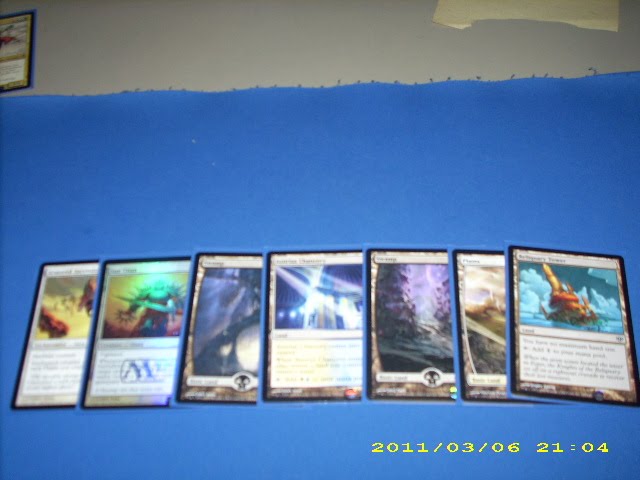
This looks like a good hand to me personally. No spells to cast, but I have a first-turn reliquary tower, which is always a good sign, and plenty of land and all three colors.
- Goldfish
A "goldfish" is basically a solitare game that you play against no opponent. You simply draw cards, play land, cast spells, and repeat this process. The goal is to see if the cards you picked are doing what you expected them to do. Is your deck following your strategy? Are the expected synergies there? In the right quantities? At any point do you want some effect that simply isn't in your deck?

After a particularly extended Goldfish, I decide to debate prior card choices. I wanted more Auras during the game, so here I consider two I previously cut (left) for some less synergistic enchantments from my deck (right)
- Live test
Of course some of the best feedback you can get for any deck is to take it to a game table near you and play it against another player playing one of their own decks. It forces you to deal with threats, interact with what your opponent has on the field, plus get another player's opinion on how, how well, and why your deck works (or doesn't).
- So is it done?
Of course not! Yes you have a playable deck, and it might even be reasonably good. But you can learn more about magic, you can become a better player, and you can become a better deck builder. As you grow, so can your deck. You can revise it to make it better. Or you can revise it to make it more fun. Or you can revise it so that it focuses on a different theme or sub-theme. Or you can build a new deck (one of my favorites).
Whatever it is you do, have fun slinging some spells!
Saturday, March 26, 2011
Commander: It's all in the cards.
= It's all in the cards.
If you've never built a Commander deck before, it kinda goes without saying that your going to need cards to build with. Even someone like myself who's a big fan of the format with multiple decks under my belt, goes out of their way to acquire cards when attempting to build a new Commander deck.
You're going to need a lot of cards.

Ok, maybe not that many. Although you can build with every card ever printed, remember the limitations of the Commander format. You have to stay in-color with your chosen Commander, you can only run one copy of any given card. You can also start picking your effects now. Running black, but creatures not a big part of your game plan? Don't grab Raise Dead or similar effects. Also low cost creatures (without abilities) are dead draws in Commander as a format

Ah, that's more like it. This is where my last 2 Commander decks started. As approximately 400 loose cards. It took me roughly 4 months to accumulate the selection you see before you by trading with other players, as well as with my FLGS (friendly local gaming store). I spend a good deal of store credit and some cash both locally and online to get this selection of cards to build from.
I want to say that it's OK to have a list of specific Cards that you want to see in your deck. I strongly urge beginners to not build complete deck lists that they see online. Often these lists include expensive singles and aren't going to fit your play style. If you are picking the cards, then there's a good chance the deck is going to be fun for you!
- The Building Process
Why start with so many cards? Because it's relatively easy to cut cards you don't like or don't want. Also starting with 400 cards and cutting down to 60 (not including land), ensures that you get everything you need (but maybe not everything you want) into the deck. Also I find it preferable to finding yourself a few cards short, and attempting to fill those slots with miscellaneous commons you have lying around that quite possibly aren't going to work for your game plan or be syngeristic with the rest of your deck. Worst case scenario they might even work against you. Whereas if you find such cards in your stack of 400, you can simply cut them from consideration, or swap them out for cards you've already cut - but are better than junk.
- Sort your cards
You need to know what you have, before you can get building. I highly suggest sorting all your cards by color and card type. This gives you an idea of what resources your dealing with. It allows you to review your card choices, revise your overall game plan, find patterns, recognize cards that are going to make just about any cut, etc.
The only cards you should cut at this point are those that you have more than one copy of (a no-no for Commander).

Here I have my collection of cards for Zur spread out in front of me. The first row is Non-basic land, then Enchantments by color. The second row is the Commander (Zur), then auras by color. The third row is non-aura, non-creatures by color. The last row is creatures by color.

Slightly more dramatically the stacks are photographed here (left to right) as: Non-basic lands, Enchantments, Auras, Artifacts, Other spells (instants, sorceries, planeswalkers), and creatures.
- The First Cut
Well, the deck cannot come together unless we start to cut cards. I take time to look at each pile that I've made. Within each card type I sort the cards further. Cards that seem really good or fun go into one pile. Cards that seem strong or interesting go into another. Marginal cards go into a third, and cards that I just plain don't like go in a fourth.
Let's not mince words. Your goal here is to cut cards. You should be as brutal as you dare. I typically scoop up the weaker two piles and return them to the box. Culling close to half of my selection in the first or second go-arround.

First cut complete. Looking at the box of 'cut' cards it looks like I managed somewhere below half, but not by much. Not a bad thing.
- Creatures
Creatures are very important to any Commander deck, as they represent the Aggro part of any deck's strategy. Creatures can slowly and incrementally win you just about any game by attacking. Thus any deck should have a few big fat creatures that can win the game conventionally. It's also a good idea to invest some card slots in creatures that have utility functions like fetching land, killing other creatures, destroying pesky permanents (like artifacts or enchantments), and so forth. This is true even if your game plan is to control & combo.
I mentioned "Card slots" there. Let me explain a bit. A commander deck has to be exactly 100 cards. No more, and no less. So when you commit yourself to running a specific card, you've locked that in. By deciding that Zur wants about 20 creatures, and cutting my pile of creatures down to 20 cards, I've not only consumed 20 of my 100 cards total, but I've consumed 20 of my 20 creature cards total.

My 20 creatures, sorted by casting cost ... for now.
- Cut and Cut some more!
This is a process you repeat and repeat again for each stack. Each time you pick up a stack, you try to cut more cards. You distill the piles of junk into stacks of cards that (1) work with your strategy, (2) work synergistically with your other cards, and (3) you really _really_ like!

This picture I snapped somewhere around my 5th or 6th attempt to cut cards. At this point in time I still had 70-some odd cards on the table, and had to cut another 10-15 to pair it down to my final 60. Why 60? Because you need to run Land, and 40 percent is about right for a Commander deck whose spells typically peak in the 3-5 range, and go up to 10. Also keep in mind that I have limited mana-ramping in my chosen colors.
It goes without saying that each time you go back to cut cards, it's going to be more difficult. You may end up revising exactly how many cards your setting aside for creatures, for example. To make more space for say ... enchantments. Which is something I did for Zur.
It might also help to sort your cards using different Criteria. Sorting them by mana cost is something I like to do when I only have a few cards left to cut. I look for mana costs that have a lot of cards at that cost. I then look at all the cards that cost the same, and try to cut a card or two that aren't worth the mana investment compared to other cards of the same cost. I'm particularly critical of spells costing six or more. With that kind of mana investment I should get something that's going to significantly impact the game.

Some more Zur cards, sorted by cost.
You may also want to sort by color. In a multi-color deck like the one I'm building this helps identify if your relying on one color too heavily, or ignoring another.

Looks like it could be a case of too much white, not enough black?
After agonizing over card choices for a while, you eventually settle on a stack that you feel is playable. I ended up with ... 19 Creatures, 11 Other spells, 15 Auras, and 15 Enchantments. Yeah that's 30 total enchantments, but you have to remember that I am building around Zur. Incedentally 20 of those enchantments are casting cost 3 or less, and thus suitable fetches for Zur's ability.
- Mana Balance.
Land is vital to the performance of the deck. The key to figuring out what kind of land you want to run is figuring out what colors your deck is. I know you know what colors your deck is, but the trick is to run land in the right proportion. This is of course a moot point if you happen to be running a mono-colored deck. It's less of a concern for two-color decks, but I would still recommend this process for them. I find it absolutely necessary to do this for 3-5 color decks of any style.
I've worked out an algorithm that works for me and I use for nearly all my magic decks.
(1) Count the number of mana symbols on each card.
I do this step with pen and paper. Using tally marks to mark how many mana symbols of each color appears on each card. I include mana symbols that appear in rules text also. Hybrid symbols count as both colors. Thus Debtors' Knell adds both 3 white and 3 black tallies to my sheet.
Debtors' Knell
(2) Total the number of symbols in each color, and Total mana symbols overall.
For Zur I had 55 white symbols, 30 blue, and 29 black, the deck has a total of 114 mana symbols.
(3) Find the percent of each color in your deck.
This is the number of symbols in a specific color divided by the total symbols in the deck.
(decimals used for accuracy)
White = 55 / 114 = 48.24%
Blue = 30 / 114 = 26.31%
Black = 29 / 114 = 25.43%
(4) Figure out how many land slots your running.
Zur was going to be running 40 land, but I had 20 non-basics to deal with first. Looking at my non-basics I found 14 that I could effectively ignore because they were colorless, any color, or completed sets of multicolor lands (Ravnica bounce and Lorwyn filters). This leaves me with 26 land slots to fill. Note that 6 of these slots will be filled by my remaining 6 non-basics.
(5) Find the number of mana sources you need of each color.
(Land slots multiplied by the percent of the deck in the color your working with above).
White = 26 x .4824 = 12.54 White sources
Blue = 26 x .2631 = 6.84 Blue sources
Black = 26 x .25.43 = 6.61 Black Sources
(6) Get your Basics.
I substituted 2 plains for a Serra's Sanctum and a Celestial Colonnade from my remaining stack of non-basics, and added 10 Plains. (12 Sources).
I substituted 2 Islands for a Faerie Conclave, and Creeping Tar Pit, and grabbed 5 Islands (7 Sources).
I substituted 2 Swamps for a Bojuka Bog and Dreadship Reef, and grabbed 5 Swamps (7 Sources).
Congratulations, you are now ready to sleeve up your deck and give it a test or two.

Um, please use sleeves. You spent all that time and money making this deck, give it some respect. Plus I cringe when I see people shuffle up without them.
If you've never built a Commander deck before, it kinda goes without saying that your going to need cards to build with. Even someone like myself who's a big fan of the format with multiple decks under my belt, goes out of their way to acquire cards when attempting to build a new Commander deck.
You're going to need a lot of cards.

Ok, maybe not that many. Although you can build with every card ever printed, remember the limitations of the Commander format. You have to stay in-color with your chosen Commander, you can only run one copy of any given card. You can also start picking your effects now. Running black, but creatures not a big part of your game plan? Don't grab Raise Dead or similar effects. Also low cost creatures (without abilities) are dead draws in Commander as a format

Ah, that's more like it. This is where my last 2 Commander decks started. As approximately 400 loose cards. It took me roughly 4 months to accumulate the selection you see before you by trading with other players, as well as with my FLGS (friendly local gaming store). I spend a good deal of store credit and some cash both locally and online to get this selection of cards to build from.
I want to say that it's OK to have a list of specific Cards that you want to see in your deck. I strongly urge beginners to not build complete deck lists that they see online. Often these lists include expensive singles and aren't going to fit your play style. If you are picking the cards, then there's a good chance the deck is going to be fun for you!
- The Building Process
Why start with so many cards? Because it's relatively easy to cut cards you don't like or don't want. Also starting with 400 cards and cutting down to 60 (not including land), ensures that you get everything you need (but maybe not everything you want) into the deck. Also I find it preferable to finding yourself a few cards short, and attempting to fill those slots with miscellaneous commons you have lying around that quite possibly aren't going to work for your game plan or be syngeristic with the rest of your deck. Worst case scenario they might even work against you. Whereas if you find such cards in your stack of 400, you can simply cut them from consideration, or swap them out for cards you've already cut - but are better than junk.
- Sort your cards
You need to know what you have, before you can get building. I highly suggest sorting all your cards by color and card type. This gives you an idea of what resources your dealing with. It allows you to review your card choices, revise your overall game plan, find patterns, recognize cards that are going to make just about any cut, etc.
The only cards you should cut at this point are those that you have more than one copy of (a no-no for Commander).

Here I have my collection of cards for Zur spread out in front of me. The first row is Non-basic land, then Enchantments by color. The second row is the Commander (Zur), then auras by color. The third row is non-aura, non-creatures by color. The last row is creatures by color.

Slightly more dramatically the stacks are photographed here (left to right) as: Non-basic lands, Enchantments, Auras, Artifacts, Other spells (instants, sorceries, planeswalkers), and creatures.
- The First Cut
Well, the deck cannot come together unless we start to cut cards. I take time to look at each pile that I've made. Within each card type I sort the cards further. Cards that seem really good or fun go into one pile. Cards that seem strong or interesting go into another. Marginal cards go into a third, and cards that I just plain don't like go in a fourth.
Let's not mince words. Your goal here is to cut cards. You should be as brutal as you dare. I typically scoop up the weaker two piles and return them to the box. Culling close to half of my selection in the first or second go-arround.

First cut complete. Looking at the box of 'cut' cards it looks like I managed somewhere below half, but not by much. Not a bad thing.
- Creatures
Creatures are very important to any Commander deck, as they represent the Aggro part of any deck's strategy. Creatures can slowly and incrementally win you just about any game by attacking. Thus any deck should have a few big fat creatures that can win the game conventionally. It's also a good idea to invest some card slots in creatures that have utility functions like fetching land, killing other creatures, destroying pesky permanents (like artifacts or enchantments), and so forth. This is true even if your game plan is to control & combo.
I mentioned "Card slots" there. Let me explain a bit. A commander deck has to be exactly 100 cards. No more, and no less. So when you commit yourself to running a specific card, you've locked that in. By deciding that Zur wants about 20 creatures, and cutting my pile of creatures down to 20 cards, I've not only consumed 20 of my 100 cards total, but I've consumed 20 of my 20 creature cards total.

My 20 creatures, sorted by casting cost ... for now.
- Cut and Cut some more!
This is a process you repeat and repeat again for each stack. Each time you pick up a stack, you try to cut more cards. You distill the piles of junk into stacks of cards that (1) work with your strategy, (2) work synergistically with your other cards, and (3) you really _really_ like!

This picture I snapped somewhere around my 5th or 6th attempt to cut cards. At this point in time I still had 70-some odd cards on the table, and had to cut another 10-15 to pair it down to my final 60. Why 60? Because you need to run Land, and 40 percent is about right for a Commander deck whose spells typically peak in the 3-5 range, and go up to 10. Also keep in mind that I have limited mana-ramping in my chosen colors.
It goes without saying that each time you go back to cut cards, it's going to be more difficult. You may end up revising exactly how many cards your setting aside for creatures, for example. To make more space for say ... enchantments. Which is something I did for Zur.
It might also help to sort your cards using different Criteria. Sorting them by mana cost is something I like to do when I only have a few cards left to cut. I look for mana costs that have a lot of cards at that cost. I then look at all the cards that cost the same, and try to cut a card or two that aren't worth the mana investment compared to other cards of the same cost. I'm particularly critical of spells costing six or more. With that kind of mana investment I should get something that's going to significantly impact the game.

Some more Zur cards, sorted by cost.
You may also want to sort by color. In a multi-color deck like the one I'm building this helps identify if your relying on one color too heavily, or ignoring another.

Looks like it could be a case of too much white, not enough black?
After agonizing over card choices for a while, you eventually settle on a stack that you feel is playable. I ended up with ... 19 Creatures, 11 Other spells, 15 Auras, and 15 Enchantments. Yeah that's 30 total enchantments, but you have to remember that I am building around Zur. Incedentally 20 of those enchantments are casting cost 3 or less, and thus suitable fetches for Zur's ability.
- Mana Balance.
Land is vital to the performance of the deck. The key to figuring out what kind of land you want to run is figuring out what colors your deck is. I know you know what colors your deck is, but the trick is to run land in the right proportion. This is of course a moot point if you happen to be running a mono-colored deck. It's less of a concern for two-color decks, but I would still recommend this process for them. I find it absolutely necessary to do this for 3-5 color decks of any style.
I've worked out an algorithm that works for me and I use for nearly all my magic decks.
(1) Count the number of mana symbols on each card.
I do this step with pen and paper. Using tally marks to mark how many mana symbols of each color appears on each card. I include mana symbols that appear in rules text also. Hybrid symbols count as both colors. Thus Debtors' Knell adds both 3 white and 3 black tallies to my sheet.
Debtors' Knell
(2) Total the number of symbols in each color, and Total mana symbols overall.
For Zur I had 55 white symbols, 30 blue, and 29 black, the deck has a total of 114 mana symbols.
(3) Find the percent of each color in your deck.
This is the number of symbols in a specific color divided by the total symbols in the deck.
(decimals used for accuracy)
White = 55 / 114 = 48.24%
Blue = 30 / 114 = 26.31%
Black = 29 / 114 = 25.43%
(4) Figure out how many land slots your running.
Zur was going to be running 40 land, but I had 20 non-basics to deal with first. Looking at my non-basics I found 14 that I could effectively ignore because they were colorless, any color, or completed sets of multicolor lands (Ravnica bounce and Lorwyn filters). This leaves me with 26 land slots to fill. Note that 6 of these slots will be filled by my remaining 6 non-basics.
(5) Find the number of mana sources you need of each color.
(Land slots multiplied by the percent of the deck in the color your working with above).
White = 26 x .4824 = 12.54 White sources
Blue = 26 x .2631 = 6.84 Blue sources
Black = 26 x .25.43 = 6.61 Black Sources
(6) Get your Basics.
I substituted 2 plains for a Serra's Sanctum and a Celestial Colonnade from my remaining stack of non-basics, and added 10 Plains. (12 Sources).
I substituted 2 Islands for a Faerie Conclave, and Creeping Tar Pit, and grabbed 5 Islands (7 Sources).
I substituted 2 Swamps for a Bojuka Bog and Dreadship Reef, and grabbed 5 Swamps (7 Sources).
Congratulations, you are now ready to sleeve up your deck and give it a test or two.

Um, please use sleeves. You spent all that time and money making this deck, give it some respect. Plus I cringe when I see people shuffle up without them.
Sunday, March 20, 2011
Commander: Having a Plan
= Having A plan
Last week I introduced Commander as a format, this time I'm going to write about how one can go about building a Commander deck.
The reason why I'm writing about the Commander format lately is because I recently completed my fourth Commander deck (well, that and because I enjoy it). Except for my first Commander deck, I have followed a series of steps and phases when building decks of this type. I have worked out a framework for how to build a successful commander deck. Thus far, it has turned out 2 reasonably good decks in my local play group. Hopefully this newest one will be the third. I thought I'd share what exactly this framework entails. Hopefully this will enlighten those new to the format, inspire those who want to get into the format, and encourage those already in the format.
Let's say your interested in putting together a Commander deck, but you don't know where to start. You need to set yourself on a road map, develop a plan, and work out a strategy. Probably the most important question you need to ask yourself is what do you want the deck to do? Or more accurately, what do you find fun in Magic? (Mark Rosewater has written a handful of articles on Timmy, Johnny, and Spike which can help you discover what you find fun in Magic).
Painting in very broad strokes every (successful) deck that has ever been built does some combination of the following.
(1) Aggro: Swing with creatures.
(2) Control: Manage the board.
(3) Combo: Get some subset of cards that do something well together.
Now I believe that a good Commander deck will actually do all three of these, but in varying amounts. Each deck is will possess an overall play style or strong focus that will be the deck's core strategy. The deck will contain multiple win conditions which will fit into one of the three strategies. I'll feed you some examples from my own Commander decks.
Thraximundar
The deck itself has lots of spells, only about 20 creatures, and focuses on effects that destroy, sacrifice, or steal cards from other players. It's primary strategy is Control.
Rith, the Awakener
This deck has a decent array of creatures, not as many spells, and focuses on effects that accelerate the game, and pump my creatures. It's primary strategy is Aggro.
Sliver Overlord
This deck is mostly creatures. Even less spells than Rith, and focuses on a wide diversity of creature-based effects. Slivers are creatures, and therefore the deck is most likely to kill by attacking (an Aggro win condition). Slivers however, are inherently synergistic creatures, and the deck does include one combo (that requires 5-7 individual cards) that allow it to explode into unlimited mana/sliver tokens, thus it has a strong synergistic component with a possible combo win condition.
- Choosing a Commander
Choosing who your Commander will be is an important and vital part of building your deck. I can't tell you who to pick as your Commander, but I can tell you that there are a few philosophies behind why people pick the creatures they do.
(1) It's just the color(s) I need.
Sometimes a player knows what color(s) they want to play, but do not have a specific Commander in mind. The different colors in magic specialize in different tasks. You want to play a specific color or colors because it's what you want the deck to do. If you want to sit there and throw burn at your opponent then you're going to be playing red. If that's going to be a primary focus of your deck you may even choose to run Jaya Ballard, Task Mage.
A player can be forced to choose using this philosophy. This occurs most frequently when a player decides on a two or three color combination that include more "enemy" colors than ally colors. For example if you really want to play Blue and Green in a commander deck you have to pick between Experiment Kraj or Momir Vig, Simic Visionary. Similarly, if you want to destroy everything with extreme prejudice in White, Black, and Red - then the only Commander available to you is Oros, the Avenger - At least until the Commander decks come out this summer.
Oros, the Avenger
(2) I'm Building around this commander.
Sometimes a player knows what commander they want, and they simply build around them. In this case, there is some rules text on the card that gives the player a parameter that they want to run with. Sometimes it's as simple as creature type. Eladamri, Lord of Leaves? Looks like mono-green elves!
More often than not the legendary creature has an ability that the player plans on using to their advantage. Sedris, the Traitor King is Blue, Black and Red. However his ability lends him to a creature-based strategy, specifically one that generates extra damage or card advantage out of bringing things back from the graveyard.
Sedris, the Traitor King
(3) This commander goes with my deck..
Sometimes a player has an idea for a deck, or set of cards they want to play, or a type of effect they want to play. The player then has to find a commander that is a "best fit" with what they want to do. Both of my Rith (Naya) and Thraximundar (Grixis) decks mentioned above evolved this way. For each deck I was considering multiple possible commanders before settling on the ones I now use.
In case your curious Rith was once in contention with Johan and Mayael the Anima. Mayael was eventually cut from the deck entirely when I determined the success rate of her ability was too low. The deck still includes a Johan, but Rith's stats I thought were generally superior and more in tune with what the deck's plan was as a whole.
As an example, I will tell you that my latest Commander creation is:
Zur the Enchanter
My planed strategy for this deck is mixed. I hope to stall the game, swing with creatures (specifically Zur), and create some synergistic situations all by using enchantments. My primary focus is to attack (with Zur), and win using Commander damage rules. I choose Zur as a build-around general (Philosophy #2).
Last week I introduced Commander as a format, this time I'm going to write about how one can go about building a Commander deck.
The reason why I'm writing about the Commander format lately is because I recently completed my fourth Commander deck (well, that and because I enjoy it). Except for my first Commander deck, I have followed a series of steps and phases when building decks of this type. I have worked out a framework for how to build a successful commander deck. Thus far, it has turned out 2 reasonably good decks in my local play group. Hopefully this newest one will be the third. I thought I'd share what exactly this framework entails. Hopefully this will enlighten those new to the format, inspire those who want to get into the format, and encourage those already in the format.
Let's say your interested in putting together a Commander deck, but you don't know where to start. You need to set yourself on a road map, develop a plan, and work out a strategy. Probably the most important question you need to ask yourself is what do you want the deck to do? Or more accurately, what do you find fun in Magic? (Mark Rosewater has written a handful of articles on Timmy, Johnny, and Spike which can help you discover what you find fun in Magic).
Painting in very broad strokes every (successful) deck that has ever been built does some combination of the following.
(1) Aggro: Swing with creatures.
(2) Control: Manage the board.
(3) Combo: Get some subset of cards that do something well together.
Now I believe that a good Commander deck will actually do all three of these, but in varying amounts. Each deck is will possess an overall play style or strong focus that will be the deck's core strategy. The deck will contain multiple win conditions which will fit into one of the three strategies. I'll feed you some examples from my own Commander decks.
Thraximundar
The deck itself has lots of spells, only about 20 creatures, and focuses on effects that destroy, sacrifice, or steal cards from other players. It's primary strategy is Control.
Rith, the Awakener
This deck has a decent array of creatures, not as many spells, and focuses on effects that accelerate the game, and pump my creatures. It's primary strategy is Aggro.
Sliver Overlord
This deck is mostly creatures. Even less spells than Rith, and focuses on a wide diversity of creature-based effects. Slivers are creatures, and therefore the deck is most likely to kill by attacking (an Aggro win condition). Slivers however, are inherently synergistic creatures, and the deck does include one combo (that requires 5-7 individual cards) that allow it to explode into unlimited mana/sliver tokens, thus it has a strong synergistic component with a possible combo win condition.
- Choosing a Commander
Choosing who your Commander will be is an important and vital part of building your deck. I can't tell you who to pick as your Commander, but I can tell you that there are a few philosophies behind why people pick the creatures they do.
(1) It's just the color(s) I need.
Sometimes a player knows what color(s) they want to play, but do not have a specific Commander in mind. The different colors in magic specialize in different tasks. You want to play a specific color or colors because it's what you want the deck to do. If you want to sit there and throw burn at your opponent then you're going to be playing red. If that's going to be a primary focus of your deck you may even choose to run Jaya Ballard, Task Mage.
A player can be forced to choose using this philosophy. This occurs most frequently when a player decides on a two or three color combination that include more "enemy" colors than ally colors. For example if you really want to play Blue and Green in a commander deck you have to pick between Experiment Kraj or Momir Vig, Simic Visionary. Similarly, if you want to destroy everything with extreme prejudice in White, Black, and Red - then the only Commander available to you is Oros, the Avenger - At least until the Commander decks come out this summer.
Oros, the Avenger
(2) I'm Building around this commander.
Sometimes a player knows what commander they want, and they simply build around them. In this case, there is some rules text on the card that gives the player a parameter that they want to run with. Sometimes it's as simple as creature type. Eladamri, Lord of Leaves? Looks like mono-green elves!
More often than not the legendary creature has an ability that the player plans on using to their advantage. Sedris, the Traitor King is Blue, Black and Red. However his ability lends him to a creature-based strategy, specifically one that generates extra damage or card advantage out of bringing things back from the graveyard.
Sedris, the Traitor King
(3) This commander goes with my deck..
Sometimes a player has an idea for a deck, or set of cards they want to play, or a type of effect they want to play. The player then has to find a commander that is a "best fit" with what they want to do. Both of my Rith (Naya) and Thraximundar (Grixis) decks mentioned above evolved this way. For each deck I was considering multiple possible commanders before settling on the ones I now use.
In case your curious Rith was once in contention with Johan and Mayael the Anima. Mayael was eventually cut from the deck entirely when I determined the success rate of her ability was too low. The deck still includes a Johan, but Rith's stats I thought were generally superior and more in tune with what the deck's plan was as a whole.
As an example, I will tell you that my latest Commander creation is:
Zur the Enchanter
My planed strategy for this deck is mixed. I hope to stall the game, swing with creatures (specifically Zur), and create some synergistic situations all by using enchantments. My primary focus is to attack (with Zur), and win using Commander damage rules. I choose Zur as a build-around general (Philosophy #2).
Monday, March 14, 2011
Commander, an introduction
= Commander, an Introduction
I sit on one end of a standard 8-foot table, one of six bodies huddled around a massive game of Highlander Commander. One of my favorite formats for casual play. The person sitting on the far side of the table has a Tefferi commander preventing me from casting anything except on my own turn. My brother has a Howling Mine and just put a Mana Flare on the table. The Tolsimir Wolfblood Deck on my immediate right just tried to cast Genisis Wave whith x=23, fortunately the blue player countered it, unfortunately there's now a 27/27 Draining whelk over there. I'm playing Thraximundar as a Commander. I have a blocker, Counterballance and Sensei's Diving Top bringing me a lot of hate, and a few cards in hand - Decree of Pain, Gutless Ghoul, Fork, Plauge Wind, and Land.
This is one of my favorite formats for several reasons.
(1) The decks are awesome. 100 cards makes for a huge deck. You can build with almost any card ever printed, barring a brief 20-some card banned list, and illegal sets like unglued (although some play groups will allow un-sets). However the restriction of building around the the colors (and sometimes abilities) of a legendary creature (your commander), and the restriction of not having anymore than one copy of any given card, except basic land, makes every deck and every game unique.
(2) The games are awesome. Interesting, difficult, bizarre and unusual cards and interactions are all possible in Commander. I find that the format keeps me on my toes and in good practice as both a player and a judge. It also enables me to share rules knowledge with my players. I mostly play multiplayer where there is an additional layer of diplomacy and picking on whomever is top dog. Although Commander can be complex, I find this aspect of it incredibly fun.
(3) The people are awesome. I am somewhat fortunate in that I have found a nest of players who all enjoy the Commander format. Some of them even enjoy it for the same reasons that I do, and this is a great blessing.
The Official website for the Commander Format can be found here:
http://mtgcommander.net/rules.php
Here's a lowdown of the major differences between Commander and the other Magic you may be more used to.
(1) Your deck must consist of exactly 100 cards (this includes your Commander).
(2) You select a single legendary creature, this creature is your Commander.
(3) When constructing your deck, you may only choose cards that are the colors in your Commander's mana cost and/or ability text.
(4) Except for basic land, you may only put one copy of any given unique card in your deck.
(5) You start the game with 40 life.
(6) When drawing your opening hand there may be an alternate mulligan rule in effect. Most groups use something called the Partial Paris mulligan.
(7) Your commander starts the game in the Command zone. You may cast your commander from the command zone any time you can normally cast a creature spell.
(8) If your commander would go to the graveyard, or exile zones, you can choose to send them to the command zone instead. If you do, the Commander costs 2 more to cast for each time it is returned to the command zone.
(9) Most likely there is a "Commander damage" rule in effect. If a player should accumulate 21 points of damage from a single commander during the course of a game, they loose the game.
I sit on one end of a standard 8-foot table, one of six bodies huddled around a massive game of Highlander Commander. One of my favorite formats for casual play. The person sitting on the far side of the table has a Tefferi commander preventing me from casting anything except on my own turn. My brother has a Howling Mine and just put a Mana Flare on the table. The Tolsimir Wolfblood Deck on my immediate right just tried to cast Genisis Wave whith x=23, fortunately the blue player countered it, unfortunately there's now a 27/27 Draining whelk over there. I'm playing Thraximundar as a Commander. I have a blocker, Counterballance and Sensei's Diving Top bringing me a lot of hate, and a few cards in hand - Decree of Pain, Gutless Ghoul, Fork, Plauge Wind, and Land.
This is one of my favorite formats for several reasons.
(1) The decks are awesome. 100 cards makes for a huge deck. You can build with almost any card ever printed, barring a brief 20-some card banned list, and illegal sets like unglued (although some play groups will allow un-sets). However the restriction of building around the the colors (and sometimes abilities) of a legendary creature (your commander), and the restriction of not having anymore than one copy of any given card, except basic land, makes every deck and every game unique.
(2) The games are awesome. Interesting, difficult, bizarre and unusual cards and interactions are all possible in Commander. I find that the format keeps me on my toes and in good practice as both a player and a judge. It also enables me to share rules knowledge with my players. I mostly play multiplayer where there is an additional layer of diplomacy and picking on whomever is top dog. Although Commander can be complex, I find this aspect of it incredibly fun.
(3) The people are awesome. I am somewhat fortunate in that I have found a nest of players who all enjoy the Commander format. Some of them even enjoy it for the same reasons that I do, and this is a great blessing.
The Official website for the Commander Format can be found here:
http://mtgcommander.net/rules.php
Here's a lowdown of the major differences between Commander and the other Magic you may be more used to.
(1) Your deck must consist of exactly 100 cards (this includes your Commander).
(2) You select a single legendary creature, this creature is your Commander.
(3) When constructing your deck, you may only choose cards that are the colors in your Commander's mana cost and/or ability text.
(4) Except for basic land, you may only put one copy of any given unique card in your deck.
(5) You start the game with 40 life.
(6) When drawing your opening hand there may be an alternate mulligan rule in effect. Most groups use something called the Partial Paris mulligan.
(7) Your commander starts the game in the Command zone. You may cast your commander from the command zone any time you can normally cast a creature spell.
(8) If your commander would go to the graveyard, or exile zones, you can choose to send them to the command zone instead. If you do, the Commander costs 2 more to cast for each time it is returned to the command zone.
(9) Most likely there is a "Commander damage" rule in effect. If a player should accumulate 21 points of damage from a single commander during the course of a game, they loose the game.
Subscribe to:
Posts (Atom)